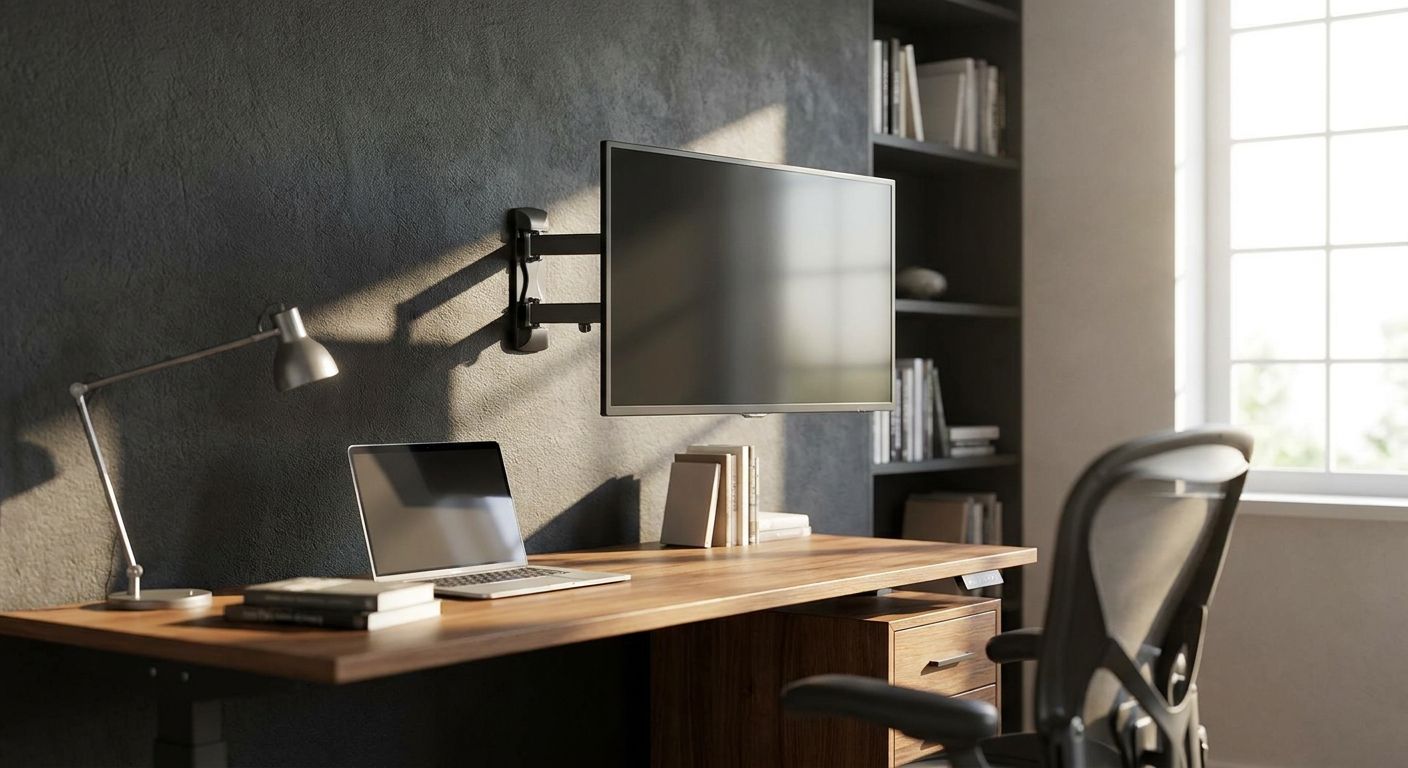
Picking the best TV mount for home office setups isn't about grabbing whatever bracket is cheapest at the hardware store — it's about matching the mount to your wall type, your desk distance, and whether you're leasing or own the space. This guide ranks six mount styles installed in Atlanta home offices throughout 2026, with a verdict on each.
- Full-motion articulating arms are the best tv mount for home office desks under 6 feet from the wall in 2026: Buy.
- Fixed low-profile mounts save 2-3 inches of wall clearance in tight home office nooks: Buy for small rooms.
- No-stud rental mounts avoid drywall damage in leased home offices: Consider, skip for TVs over 55 inches.
- Heavy-duty tilt mounts for plaster or brick walls need extra anchors most kits skip: Hold until a stud check confirms placement.
- Ceiling-drop mounts work only under sloped ceilings with no wall option: Skip for a standard home office.
Why This Matters for a Home Office
A home office TV sits closer to your eyes than a living room TV — usually 2 to 4 feet from a desk chair instead of 8 to 10 feet across a family room. That changes everything about mount selection: swivel range matters more than screen size, and video-call camera angle matters more than cinematic viewing distance.
A mount that works fine bolted to a stud in a den can be the wrong pick above a desk where you need to tilt the screen down 15 degrees to avoid glare from an overhead light, or swing it 45 degrees so it's visible from a standing desk position. Home offices also run into more plaster, brick, and rental-restricted walls than typical living rooms, since converted bonus rooms and older Atlanta homes get pressed into office duty.
How These Mounts Are Ranked
The rankings below come from installation patterns across more than 10,000 TVs mounted in metro Atlanta homes, cross-checked against manufacturer VESA and weight-capacity specs for each mount category. The TV Mount Men is licensed and insured, and every mount install carries a 5-year warranty regardless of wall type — that's the baseline every category below gets measured against.
Each entry accounts for wall compatibility, monitor arm interference (a real problem in home offices with dual monitors), and how the mount behaves during video calls where the viewing angle shifts constantly. Home office TV mounting covers the install side of this in more depth if you want the full walkthrough.
The Best TV Mounts for a Home Office, Ranked
1. Full-Motion Articulating Arm — The Workhorse Pick
Full-motion mounts extend 20+ inches from the wall and swivel through roughly 180 degrees, which matters when your desk sits perpendicular to the wall instead of facing it head-on. Most support VESA patterns up to 400x400mm, covering the majority of 32-to-65-inch TVs used as secondary office displays.
The pull-and-swing motion is the whole point for home offices: you extend the arm to face the desk during work hours, then push it flat against the wall when the room doubles as a guest space. Verdict: Buy — this is the default recommendation for any home office where the desk isn't already flush against the same wall as the TV.
2. Fixed Low-Profile Mount — The Space Saver
A fixed mount holds the TV within 1 to 2 inches of the wall with zero tilt or swivel. That's a real advantage in small home offices where a closet has been converted into a workspace and every inch of depth counts.
The tradeoff is obvious: no angle adjustment once it's up. This works when the TV sits directly across from the desk at seated eye level and never needs repositioning. Verdict: Buy for cramped rooms, but skip it if the desk faces the wall at any angle other than straight-on.
3. Tilting Mount — The Compromise Pick
Tilting mounts move 5 to 15 degrees vertically without the horizontal swing of a full-motion arm. They're the right call when a home office TV has to hang above eye level — over a bookshelf or credenza — because the downward tilt kills glare from monitor lights and windows.
They cost less mechanical complexity than full-motion arms and hold heavier TVs more securely since there's no extended arm putting torque on the wall plate. Verdict: Consider for above-shelf placements; skip it if the TV sits at proper seated eye level, since tilt adds nothing there.
4. No-Stud Rental-Safe Mount — The Renter's Pick
Rental-safe mounts use specialty anchors rated for drywall alone, avoiding the wall damage that comes with standard lag-bolt installs into studs. They're built for leased home offices where the lease agreement restricts permanent wall modifications.
The catch is weight capacity — most rental-safe hardware tops out well below what a stud-mounted bracket can hold, so anything over roughly 55 inches pushes past what these anchors are rated for. Full details on which anchor types work for which lease terms are in the rental-safe TV mount guide. Verdict: Consider for TVs 55 inches and under in a leased space; Skip for larger screens or anything permanent.
5. Heavy-Duty Mount for Plaster or Brick Walls — The Older-Home Fix
Older Atlanta homes converted into home offices frequently have plaster-over-lath walls or exposed brick, neither of which behaves like standard drywall. A heavy-duty mount rated for masonry anchors or plaster-specific hardware is the only safe option — a standard drywall toggle bolt kit will pull straight out of plaster under load.
The difference shows up during the stud-and-wall-type check before installation, not in the mount itself. The plaster and textured wall mounting guide walks through which anchor types hold in each wall condition. Verdict: Hold until a wall-type check confirms plaster, brick, or standard drywall — the wrong anchor choice here is the single most common cause of a mount failing.
6. Heavy-Duty Mount for Converted Garages and Bonus Rooms — The Bonus-Room Pick
Garages and bonus rooms converted into home offices often have unfinished or uninsulated wall sections, sometimes with studs spaced differently than standard 16-inch residential framing. A heavy-duty mount built for wider stud spacing and unfinished surfaces handles this correctly where a standard kit won't align with the studs at all.
This is a narrow use case — it only applies when the office sits in a converted garage or similar space rather than a finished interior room. Verdict: Buy for garage or bonus-room conversions; Skip it for a standard finished-drywall home office, where a full-motion or low-profile mount does the job with simpler hardware.
Comparison Table
| Mount Type | Best For | Wall Requirement | 2026 Verdict |
|---|---|---|---|
| Full-motion articulating arm | Desks at an angle to the TV wall | Standard drywall over studs | Buy |
| Fixed low-profile | Small offices, TV directly across from desk | Standard drywall over studs | Buy for small rooms |
| Tilting | TVs mounted above eye level | Standard drywall over studs | Consider |
| No-stud rental-safe | Leased offices, TVs 55" and under | Drywall only, no studs required | Consider / Skip over 55" |
| Heavy-duty (plaster/brick) | Older Atlanta homes | Plaster, lath, or brick | Hold until wall-type check |
| Heavy-duty (garage/bonus room) | Converted garage or bonus room offices | Unfinished or wide-spaced studs | Buy for conversions only |
Where to Get It Installed
- Check the wall type before buying hardware. Plaster, brick, and standard drywall each need different anchors, and the wrong choice is the leading cause of a mount pulling loose.
- Confirm weight capacity against the actual TV, not the box estimate. A 55-inch TV with a heavy stand base can exceed the rated capacity of a lightweight rental-safe mount even though the screen size fits.
- Use a licensed, insured installer for anything involving a new outlet behind the TV. The TV Mount Men runs outlet installs behind the mount as part of the same visit, which keeps a home office cord-free without a separate electrician trip.
Get your home office TV mounted right
Licensed, insured installs across metro Atlanta with a 5-year warranty.
FAQ
What's the best tv mount for home office desks in 2026?
A full-motion articulating arm is the best tv mount for home office desks in 2026 when the desk isn't directly facing the wall. It swivels roughly 180 degrees, which matters for video calls and angled desk placement.
Is a fixed mount better than a full-motion mount for a home office?
A fixed mount is better only when the TV sits directly across from the desk with no need to angle it, and when wall clearance is tight. A full-motion mount handles any other desk layout better because it swivels toward the seating position.
Can I mount a TV in a rented home office without damaging the wall?
Yes, no-stud rental-safe mounts use drywall-rated anchors instead of lag bolts into studs, avoiding permanent damage. They're rated for TVs up to roughly 55 inches, so larger screens need a standard stud-mounted bracket instead.
What height should a TV mount be for a home office?
Home office TVs should sit at seated eye level, roughly 42 to 48 inches from the floor, well below the 55 to 60 inch height typical in living rooms. That height keeps video-call framing correct and avoids neck strain during long work sessions.
Do I need a different mount for plaster or brick walls in an older home office?
Yes, standard drywall anchors pull loose from plaster and won't hold in brick at all. A heavy-duty mount paired with masonry-rated or plaster-specific anchors is required for either wall type.
How much weight can a home office TV mount hold?
Weight capacity varies by mount category, with rental-safe and low-profile mounts rated lower than full-motion or heavy-duty brackets. Always match the mount's rated capacity to the TV's actual weight, not just its screen size.
Should a home office TV mount include an outlet behind the screen?
A new outlet behind the TV is common in home office installs to keep cords hidden and off the desk. It's typically added during the same mounting visit rather than as a separate electrical job.
One Last Thing
Most people mount a home office TV at the same height they'd use in a living room, then wonder why their video calls look off. Seated eye level in an office chair runs 42 to 48 inches from the floor — a full foot lower than the 55 to 60 inch height that works for a couch across the room. Get the height wrong and no mount type on this list fixes it.