Converted garages and bonus rooms create TV mounting problems that finished living rooms never see: cinderblock or metal-stud walls instead of wood studs, no HVAC to keep temperature and humidity stable, and ceiling heights built for storage racks, not sightlines. The wrong mount either pulls loose within a year or leaves you staring up at a screen that should be at eye level.
- A heavy-duty fixed mount rated for masonry or metal studs is the best tv mount for garage walls without drywall backing.
- Full-motion articulating mounts fit bonus rooms with seating on more than one wall - buy for flexible layouts.
- Weatherproof-rated mounts are the only safe pick for uninsulated garages with 40-plus degree swings between winter and summer.
- Standard drywall tilt mounts are a skip on cinderblock or metal-stud garage walls - they pull loose within months.
Why this matters
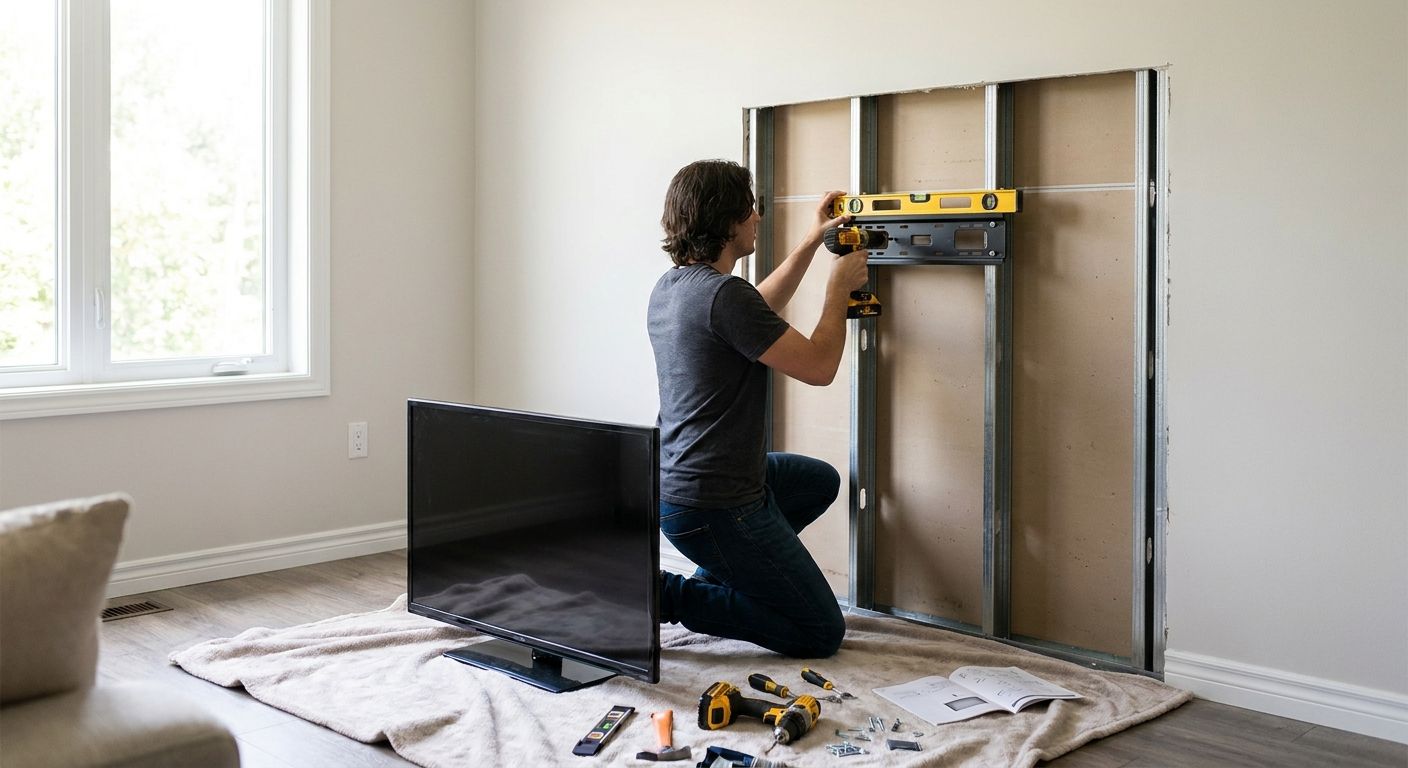
A garage or bonus room is not a smaller version of a living room. The wall behind the TV is often cinderblock, poured concrete, or 20-gauge metal studs instead of standard 16-inch-on-center wood framing, which changes the hardware you need before you touch the mount itself. Garage and workshop TV mounting jobs across metro Atlanta run into this constantly: a mount rated for drywall anchors simply has nothing to bite into on a block wall.
Temperature swings matter too. An uninsulated garage in Woodstock or Acworth, GA can run 40-plus degrees colder in January than in July, and that cycling stresses plastic mount components and electronics differently than a climate-controlled den. Picking the right mount category first, then the right bracket within it, is what keeps a 2026 install looking the same in 2029.
How we ranked
Each mount type below is scored against three factors specific to converted spaces: what wall material it actually needs to anchor into, how it performs across temperature and humidity swings, and whether the viewing geometry of a garage or bonus room (often a single long wall, sometimes an L-shaped layout) suits a fixed, tilting, or full-motion arm. Weight and VESA capacity figures reflect commonly published specs for each mount category, not a single branded product. The credentials behind this ranking: TV Mount Men has completed 10,000-plus installations across metro Atlanta and backs every job with a 5-year warranty, which means the failure patterns below come from real wall types, not lab conditions.
The ranked list
1. Heavy-Duty Fixed Mount for Masonry and Metal-Stud Walls
The safe pick when the garage wall is cinderblock, poured concrete, or metal stud rather than wood-framed drywall. A heavy-duty fixed mount paired with masonry sleeve anchors or toggle-style metal-stud hardware holds screens in the 55-to-75-inch range without the wobble a standard drywall bracket introduces on these surfaces. It sits flush to the wall, which matters in a garage where clearance around a workbench or storage shelving is already tight. Verdict: Buy for any garage wall that isn't standard wood-framed drywall.
2. Full-Motion Articulating Mount for Multi-Angle Seating
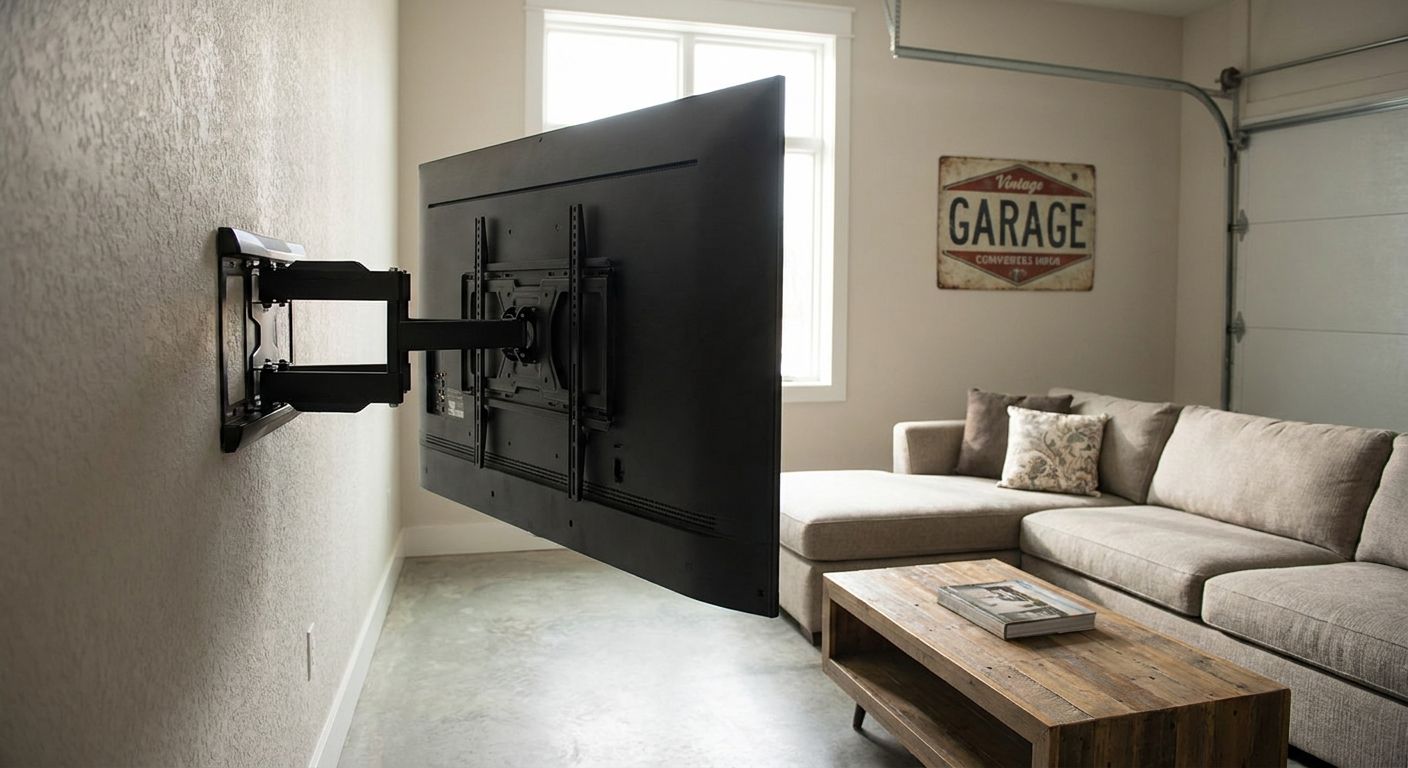
The flexible pick for a bonus room converted into a home gym, playroom, or flex lounge where seating isn't fixed to one wall. Full-motion mounts commonly extend 18 to 24 inches from the wall and swivel up to 180 degrees, letting the screen follow a treadmill user or a couch that gets rearranged. TV mounting for home gyms covers the same swivel-and-extend logic for rooms where the viewing angle changes by activity, not just by seat. Verdict: Buy for bonus rooms with more than one seating zone.
3. Tilt Mount for High Workbench Placement
The workbench-height fix when the TV has to sit above eye level to clear tools, shelving, or a garage door track. Tilt mounts typically offer 5 to 15 degrees of downward angle, which corrects glare and neck strain when the screen sits 7 feet or higher off the concrete floor. The tradeoff is that tilt mounts assume standard wood-stud or solid drywall backing, so they need the same masonry hardware swap as a fixed mount if the wall is block or metal stud. Verdict: Consider only when mounting height, not wall material, is the main problem.
4. Weatherproof-Rated Mount for Uninsulated Garages
The uninsulated-garage pick, and the one most DIY installs skip. A weatherproof or outdoor-rated mount uses corrosion-resistant hardware and sealed joints designed to handle the humidity swings a detached or uninsulated garage sees across a Georgia summer and winter. Outdoor TV mounts built for Georgia heat and humidity apply the same weatherproofing logic to porches and patios, and the same reasoning holds for a garage that never gets conditioned air. Verdict: Buy for any garage without HVAC.
5. Low-Profile Fixed Mount for Finished Bonus Rooms
The tight-clearance pick once a bonus room is fully finished with drywall, insulation, and climate control, closer to a converted basement than a raw garage. Low-profile mounts sit within 1 to 2 inches of the wall, which keeps a finished room looking intentional rather than like leftover garage hardware. TV mounting for basements and finished lower levels covers the same finished-space logic that applies once a bonus room stops behaving like a garage. Verdict: Buy once the room is fully finished and climate-controlled.
6. Ceiling-Drop Mount for Detached Garage Studios
The wildcard pick for a detached garage converted into a studio or man cave where wall space is taken up by storage or a workbench. A ceiling-drop mount clears the wall entirely but needs a joist or a rated ceiling anchor point, and it's the least stable option in a space with any vibration from garage door operation or nearby equipment. Verdict: Skip unless wall space genuinely does not exist.
Get your garage TV mounted right
Licensed, insured installers who handle block walls, metal studs, and outdoor-rated hardware.
What to avoid
- Standard drywall anchors on a block or metal-stud wall. They look installed correctly for the first few months, then pull loose under the screen's weight.
- Indoor-only mounts in an uninsulated garage. Plastic components rated for stable indoor temperatures degrade faster across a Georgia freeze-thaw cycle than in a conditioned room.
- Full-motion arms on a single-wall garage with no traffic reason to swivel. A fixed mount holds a heavier TV more securely and costs less to install when the viewing angle never changes.
Comparison table
| Mount type | Best wall | Weight capacity | Verdict |
|---|---|---|---|
| Heavy-duty fixed | Masonry, metal stud | Up to 100 lbs | Buy |
| Full-motion articulating | Wood stud, drywall | Up to 100 lbs | Buy |
| Tilt | Wood stud, solid drywall | Up to 90 lbs | Consider |
| Weatherproof-rated | Any, uninsulated space | Up to 100 lbs | Buy |
| Low-profile fixed | Finished drywall | Up to 90 lbs | Buy |
| Ceiling-drop | Rated ceiling joist | Up to 75 lbs | Skip |
Where to get it installed
- Confirm the wall material before ordering hardware. A stud finder reads differently on cinderblock and metal stud than on standard wood-framed drywall, and the wrong anchor is the single biggest cause of failed garage mounts.
- Match VESA pattern to the mount, not just to the TV size. A 65-inch TV can carry a 400x400 or 600x400 VESA pattern depending on the model, and a mismatched bracket won't seat correctly regardless of weight rating.
- Get an installer to verify anchor points on-site for uninsulated or detached garages. A 2026 install on a block wall needs different hardware than the same TV going up on drywall in a finished bonus room, and pricing reflects that difference.
FAQ
What is the best tv mount for garage walls made of cinderblock?
A heavy-duty fixed mount installed with masonry sleeve anchors is the best tv mount for garage cinderblock walls in 2026. Standard drywall anchors have nothing solid to bite into and will pull loose under the screen's weight within months.
Do I need a weatherproof mount for an uninsulated garage?
Yes, if the garage has no HVAC and sees the full range of a Georgia winter and summer. Weatherproof-rated mounts use corrosion-resistant hardware built for humidity swings that standard indoor mounts aren't designed to handle.
Is a full-motion mount better than a fixed mount for a bonus room?
A full-motion mount is better when seating isn't fixed to one wall, such as a home gym or flex lounge. A fixed mount holds more weight securely and costs less to install when the viewing angle never changes.
How much weight can a garage TV mount hold?
Most heavy-duty fixed and full-motion mounts on the market in 2026 support up to 100 lbs, which covers the vast majority of TVs from 55 to 85 inches. Always confirm the manufacturer's rated capacity against your specific TV weight before installing.
Can a metal-stud garage wall hold a TV mount?
Yes, but it requires toggle-style hardware rated for metal stud rather than standard drywall anchors. A heavy-duty fixed mount with the correct hardware performs the same on metal stud as it does on wood framing.
Should I mount a TV above a workbench in a garage?
A tilt mount works well above a workbench when the screen needs to sit 7 feet or higher to clear tools and shelving. The 5 to 15 degrees of downward tilt corrects the glare and neck strain that come with high placement.
Is a ceiling mount a good option for a garage TV?
Only when wall space genuinely doesn't exist, since ceiling-drop mounts are the least stable option in a space with vibration from garage door operation or nearby equipment. A wall-mounted option is the better default whenever a usable wall is available.
One last thing
The detail most DIY garage mounting projects miss isn't the bracket, it's the outlet: running a new outlet behind the TV before the mount goes up is what turns a garage or bonus room installation into a genuinely cord-free finish, the same approach used on finished basement and bedroom installs across metro Atlanta. Skip that step and even the best tv mount for garage walls ends up surrounded by visible cable runs down to the nearest existing outlet.