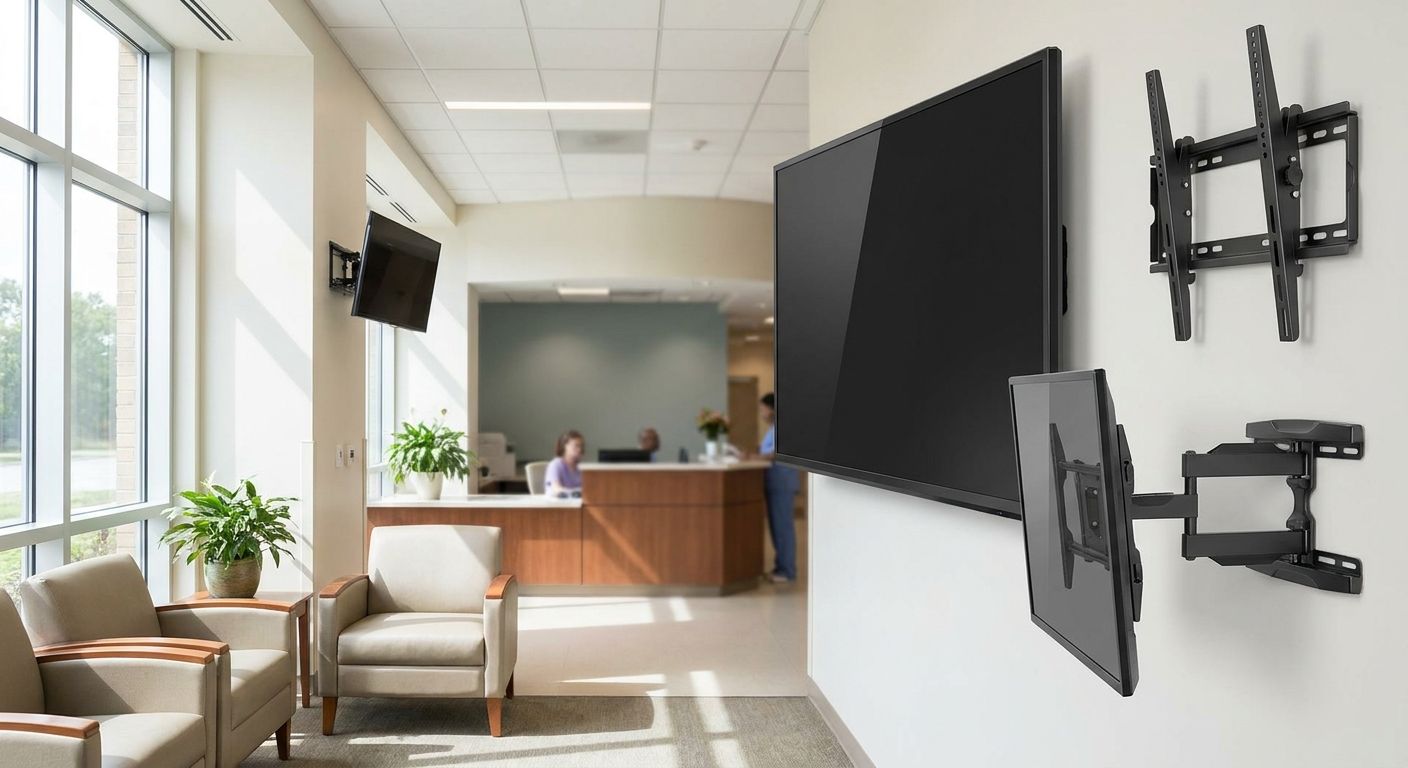
Waiting rooms need a different mounting spec than a living room does: higher foot traffic, tamper risk, and sightlines that have to work for a dozen people sitting in rows of chairs. The best tv mounting for waiting rooms in 2026 comes down to three variables — wall type, seating layout, and how much you need to lock the hardware down against tampering or theft.
- Fixed low-profile mounts are the right call for standard medical, dental, and salon waiting rooms under 55 inches — Buy.
- Full-motion articulating mounts handle L-shaped or two-wall seating layouts where one fixed angle can't cover every chair.
- Tamper-resistant hardware is standard practice for public-facing lobbies in 2026, not an upcharge.
- Multi-screen ganged mounts fit urgent care and large-practice waiting rooms running more than one display off one feed.
Why this matters
A TV mounted for a bedroom or living room assumes one seating position and one viewer who controls the remote. A waiting room has 8 to 20 people sitting at different angles, for anywhere from 5 minutes to over an hour, with zero control over the display.
Get the mount wrong and you get glare complaints, a TV tilted for the wrong sightline, or — in a public lobby — a $400 television walking out the door because it was hung on a standard tilt bracket with no locking hardware. Across tv mounting for waiting rooms and reception areas jobs in metro Atlanta, the mount type matters more than the TV brand or size.
How this list was ranked
This ranking is based on aggregated installation patterns across 10,000+ jobs completed by The TV Mount Men in metro Atlanta, weighted toward wall-mount category: what mount type gets specified for which waiting room layout, how often full-motion arms get requested for multi-wall seating, and which hardware holds up in high-traffic commercial spaces versus residential rooms.
Every solution below is rated by wall compatibility, sightline flexibility, and tamper resistance — the three factors that actually differ between a home installation and a commercial waiting room installation in 2026.
The ranked list
1. Fixed low-profile mount — the standard pick
This is the mount used in the majority of single-wall dental, medical, and salon waiting rooms. It sits flush against drywall or a stud wall, holds the TV within 1-2 inches of the surface, and doesn't tilt or swivel once installed.
For a waiting room where every chair faces one direction, a fixed mount at a 42-48 inch center height clears sightlines without the added cost of a moving arm. It's the cheapest hardware option and the least likely to loosen over time since there are no moving joints.
Verdict: Buy for single-wall waiting rooms with seating in rows facing one direction.
2. Tilt mount — for above-eye-level placement
When a waiting room mounts the TV higher than 60 inches to clear a reception desk or a doorway, a tilt mount angles the screen down 5-15 degrees to cut glare and correct the viewing angle for seated patients below.
This is the right call in front offices where the TV has to sit above a check-in counter. Without the tilt, anyone seated gets a foreshortened, glare-heavy picture.
Verdict: Buy for above-desk or above-doorway placements over 60 inches.
3. Full-motion articulating mount — for multi-wall seating
Waiting rooms shaped like an L, or with seating split across two walls, need a mount that swings 90-180 degrees and extends out from the wall on an arm. This lets the room reposition the screen depending on how full the space is, rather than locking in one fixed angle that only serves half the chairs.
It costs more than a fixed or tilt bracket and needs more wall clearance, but it solves the sightline problem that fixed mounts can't.
Verdict: Consider for reception areas over 300 square feet with seating on more than one wall.
4. Ceiling or drop-down mount — for center-of-room placement
When there's no usable wall — an interior lobby with glass on two sides, for example — a ceiling mount drops the TV down on a pole rather than hanging it flush to a wall. This is less common but solves a real problem in open-plan waiting areas with limited wall footage.
Installation runs longer than a standard wall mount because it requires locating ceiling joists or adding blocking, and cable runs have to be planned before drywall goes up if it's new construction.
Verdict: Consider for open-plan lobbies with insufficient wall space.
5. ADA-conscious height mount — for medical and senior-care waiting rooms
Medical offices, senior care facilities, and accessibility-focused practices need mounting height planned around wheelchair sightlines and lower seating, not standard adult eye-level. That typically means centering the screen a few inches lower than a standard office install and confirming there's no glare from overhead fluorescent lighting at that height.
This matters more in healthcare and senior-living settings than almost any other commercial category — a screen mounted for standing adults can sit above the sightline of a patient in a wheelchair or a low recliner. Tv mounting for senior living and accessibility needs covers this height planning in more depth.
Verdict: Buy for medical, dental, and senior-care waiting rooms.
6. Tamper-resistant hardware — for high-traffic public lobbies
Standard tilt and fixed brackets use exposed hardware that anyone with a screwdriver can remove. Tamper-resistant mounts use security screws and locking arms that require a specialized key or tool, which is the standard in 2026 for lobbies with unsupervised public access — DMV-style offices, shared building lobbies, gyms, and larger retail waiting areas.
The hardware itself costs more, but replacing a stolen 55-inch TV costs more than the upgrade every time.
Verdict: Buy for any waiting room with unsupervised public access after hours.
7. Multi-screen ganged mount — for large practices and urgent care
Waiting rooms running more than one display — one for a check-in queue number, one for content — need a ganged mount that holds two or more screens on a shared frame with independent tilt on each. This keeps cable runs consolidated to one point instead of two separate wall penetrations.
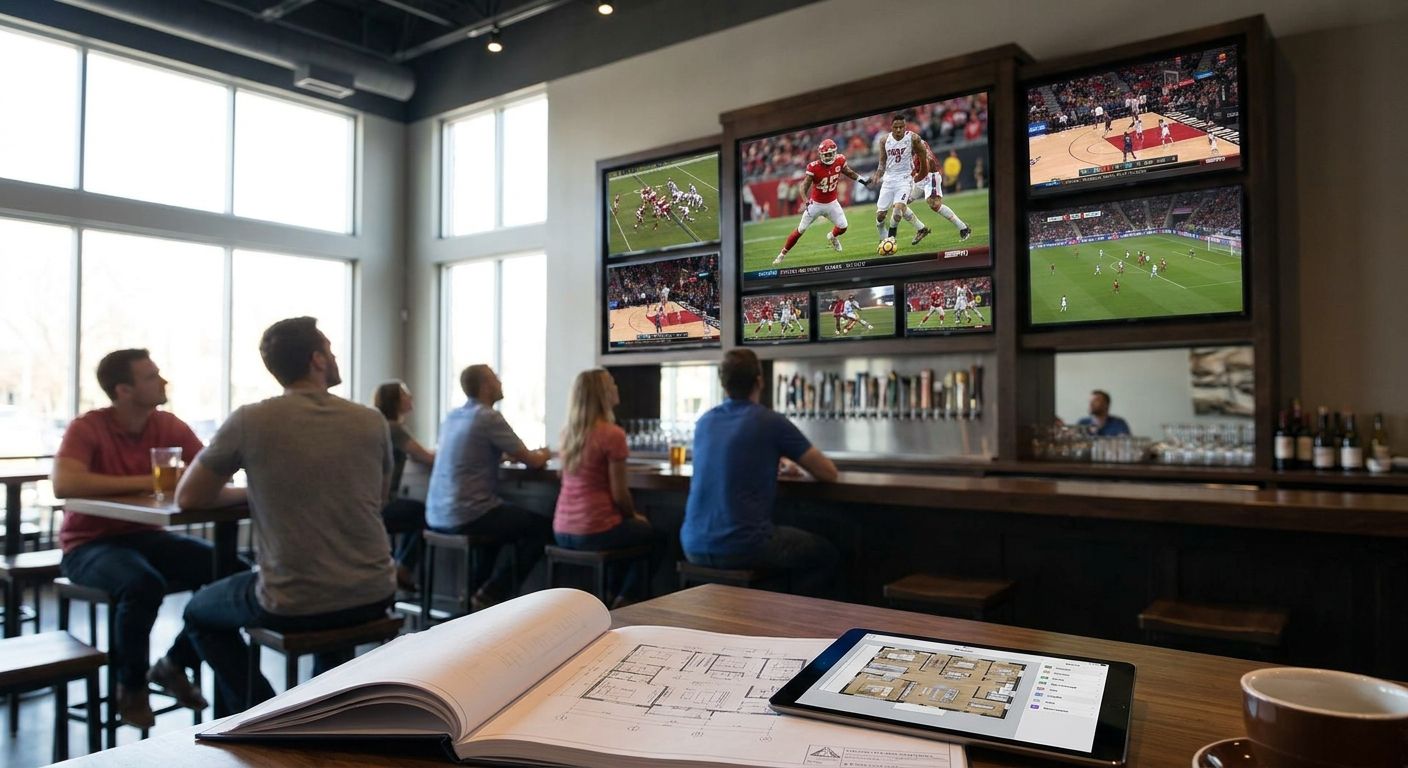
Urgent care centers and larger group practices are the main users of this configuration in metro Atlanta. The same hardware logic shows up in multi-screen sports bar mount setups, just scaled down for a waiting room's smaller footprint.
Verdict: Buy for practices running two or more displays off one power and cable point.
8. Adhesive or no-drill mount — skip this for waiting rooms
Adhesive mounts and no-drill brackets are built for rental apartments where wall damage is the concern, not commercial lobbies. They're rated for far less weight than a standard 55-65 inch commercial TV and have no tamper resistance at all.
Verdict: Skip. Not rated for commercial use or public-access spaces.
Comparison table
| Solution | Best for | Wall requirement | Tilt/swivel range | Verdict |
|---|---|---|---|---|
| Fixed low-profile | Single-wall seating | Stud or drywall anchor | None | Buy |
| Tilt mount | Above-desk placement | Stud or drywall anchor | 5-15 degrees down | Buy |
| Full-motion arm | Multi-wall seating | Stud preferred | 90-180 degrees swing | Consider |
| Ceiling/drop-down | No usable wall space | Ceiling joist | Fixed or limited swivel | Consider |
| ADA-conscious height | Medical/senior care | Stud or drywall | Depends on base mount | Buy |
| Tamper-resistant | Public/unsupervised lobbies | Stud preferred | Depends on base mount | Buy |
| Multi-screen ganged | Two-plus displays | Stud, reinforced | Independent per screen | Buy |
| Adhesive/no-drill | Never, for commercial | N/A | None | Skip |
Get a waiting room mounting quote
Licensed and insured installs across metro Atlanta, backed by a 5-year warranty.
Getting it installed: 3 sourcing rules
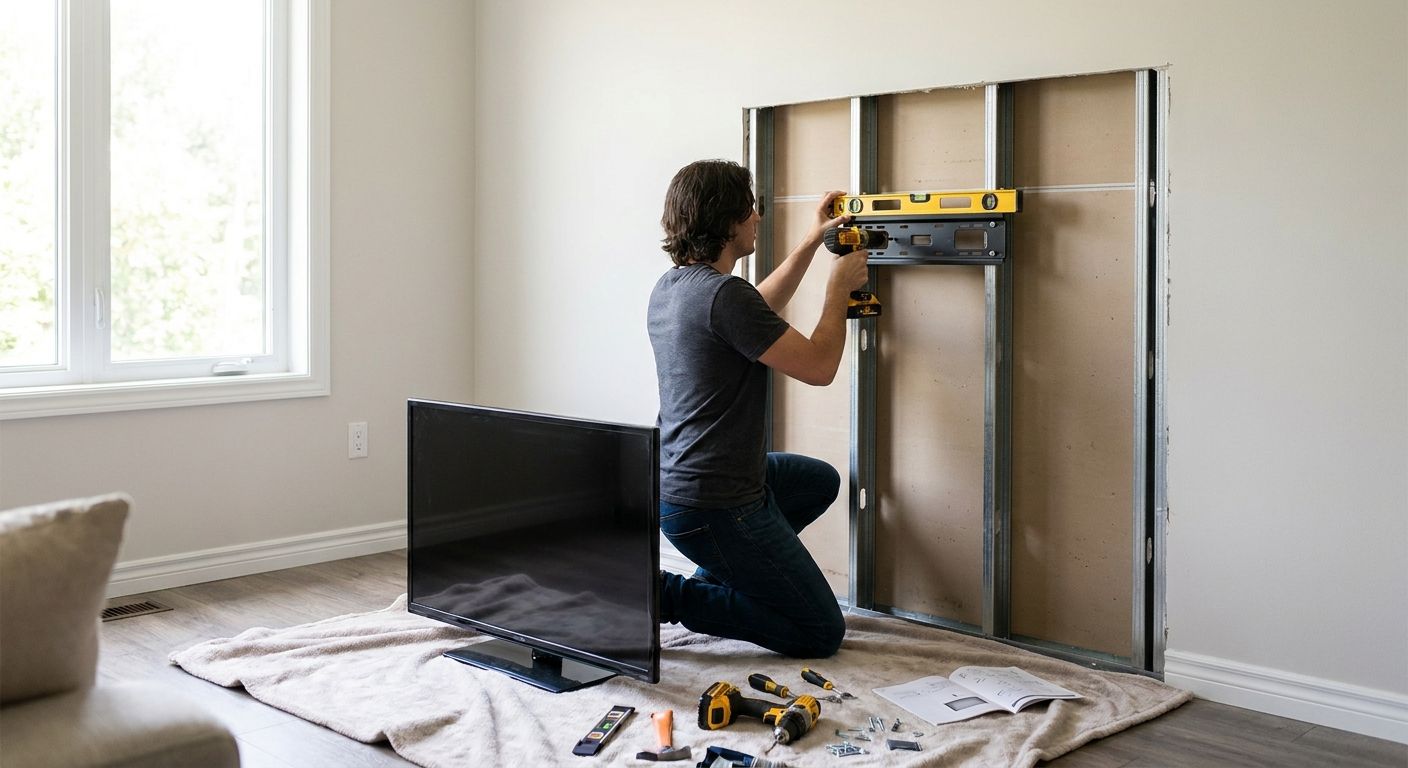
- Confirm the wall gets assessed before a bracket goes up. Drywall-only anchors fail differently than stud-mounted brackets under the vibration of a busy lobby door — a real installer checks the wall type first, not after.
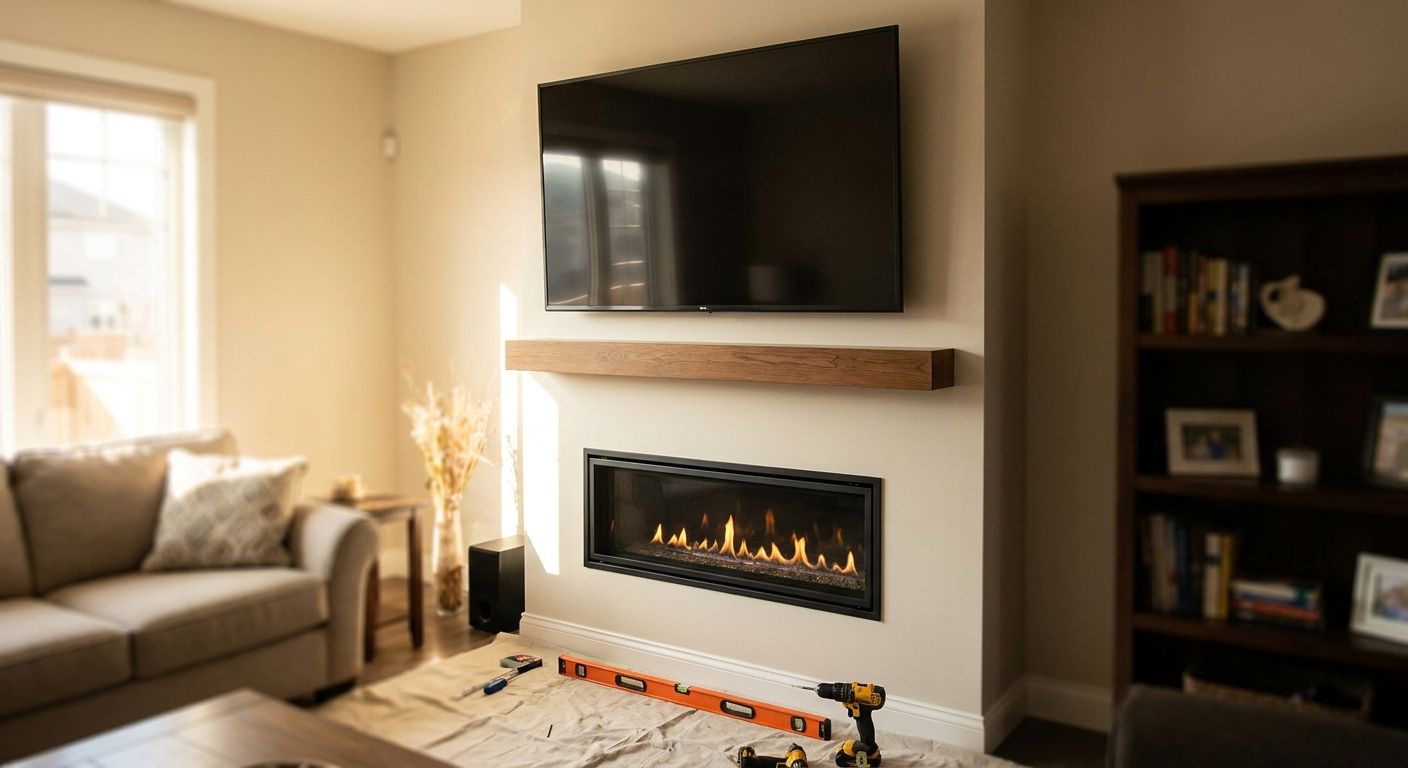
- Ask whether outlet or cable relocation is included. A waiting room TV with a visible power cord dangling to a floor outlet looks unfinished; running a new outlet behind the mount point is a standard add for a commercial install in 2026.
- Verify licensing and insurance before scheduling. Commercial spaces carry more liability exposure than a residential living room — a job backed by proof of insurance and a warranty (The TV Mount Men backs installs with a 5-year warranty and has completed 10,000+ installations across metro Atlanta) protects the practice, not just the installer.
FAQ
What's the best tv mounting for waiting rooms in 2026?
A fixed low-profile mount is the best tv mounting for waiting rooms with single-direction seating, while a tilt mount is better above a reception desk over 60 inches high. Multi-wall seating layouts need a full-motion articulating arm instead.
Should waiting room TVs use tamper-resistant mounting hardware?
Yes, tamper-resistant hardware is standard for any waiting room with unsupervised public access, such as shared lobbies or after-hours entry points. Standard exposed screws on a tilt bracket can be removed with a basic screwdriver.
How high should a TV be mounted in a medical waiting room?
Medical and senior-care waiting rooms typically mount lower than a standard 42-48 inch center height to account for wheelchair sightlines and low seating. The exact height depends on the room's seating layout and lighting.
Is a full-motion mount worth it for a waiting room?
A full-motion mount is worth it when seating is split across two walls or an L-shaped layout, since a fixed mount only serves one viewing angle. For single-wall rooms, a fixed or tilt mount handles the job for less cost.
Can a TV be mounted on drywall alone in a commercial lobby?
Drywall-only anchors work for lighter TVs but a stud-mounted bracket holds up better under the traffic and door vibration common in commercial lobbies. A wall assessment before installation determines which anchor point is safe for the TV's weight.
How many TVs should a waiting room have?
Most single-practice waiting rooms run one TV, while larger practices and urgent care centers running a check-in queue display alongside content use two screens on a ganged mount. The right count depends on room size and whether a queue system is in use.
Does mounting a TV in a waiting room require an outlet installation?
Not always, but running a new outlet behind the mount point is common for a fully cord-free finish in a commercial lobby. Without it, a power cord has to run to the nearest existing outlet, which often shows.
One last thing
The detail that gets skipped most often in waiting room installs isn't the mount type, it's the outlet. A TV hung on a $40 fixed bracket with a visible extension cord running to a floor outlet looks worse than a $200 tilt mount with a new outlet installed behind it — the mount is rarely the thing patients notice, the cord is.