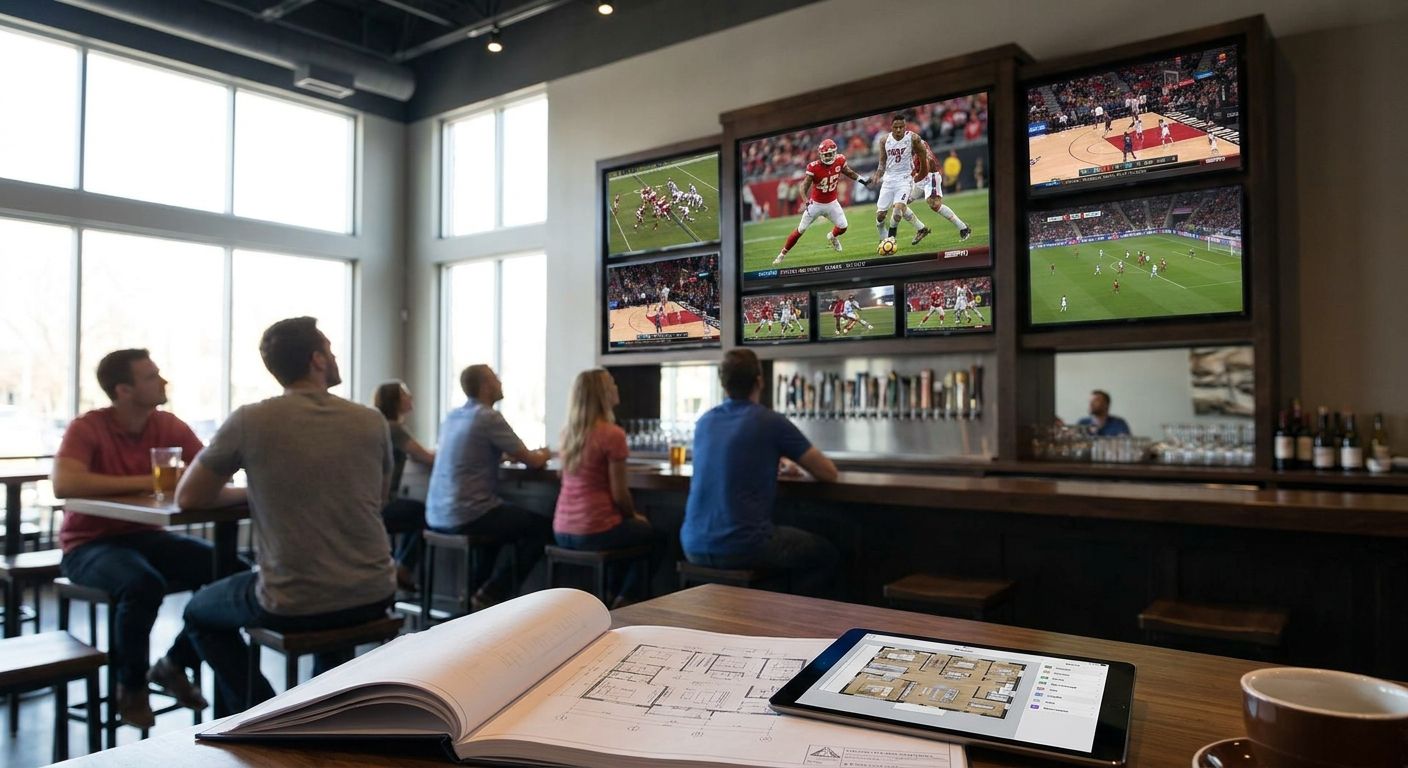
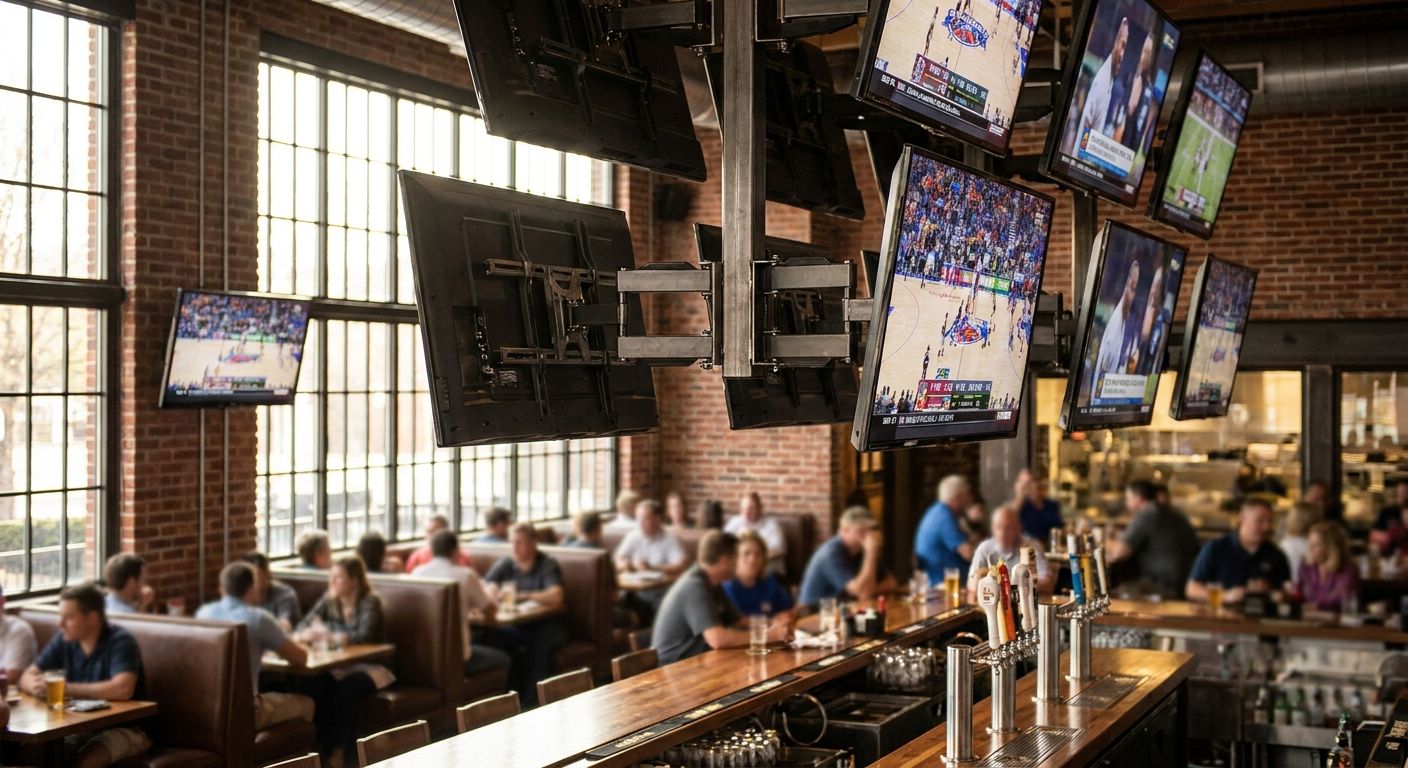
A sports bar with six screens and one bad mount is a bar with five working screens and a customer filming your falling TV for TikTok. This guide ranks the mount types that hold up in a multi-screen commercial setup in 2026, with the weight ratings and viewing-angle math that actually matter behind a bar.
- Full-motion articulating mounts are the best tv mounts for sports bar walls with mixed sightlines in 2026 — buy them for anything over 55 inches.
- Heavy-duty tilt mounts win for above-bar screens where the crowd looks up, not across.
- Outdoor-rated full-motion mounts are mandatory for covered patios — indoor mounts corrode within a season.
- Video wall mount systems only make sense at 4+ adjacent screens; anything smaller is overkill.
Why this matters
A residential mount is rated for one person occasionally adjusting the angle. A sports bar wall gets bumped by bar stools, wiped down nightly, and stares down 200+ pounds of TV and hardware for years without a break. Pick the wrong mount category and you're not looking at a cosmetic problem — you're looking at a TV coming off drywall over a packed bar on a Saturday night.
The TV Mount Men has handled sports bar and multi-screen venue installations across metro Atlanta long enough to know the failure points aren't exotic. They're almost always mount category mismatches: a fixed bracket where a tilt was needed, or a residential-grade full-motion arm carrying a 75-inch commercial panel it was never rated for.
How this list was ranked
Each mount category below is ranked on four factors that matter specifically in a commercial multi-screen environment: rated weight capacity relative to common sports bar TV sizes (55-to-100-inch), tilt or swivel range for fixed sightlines versus bar-height viewing, mounting surface compatibility (drywall, brick, block), and how the mount performs under repeated vibration and cleaning in a high-traffic venue. Mounts that only work well in a living room got dropped from the list even if they're popular online. Every verdict below assumes commercial installation, not a DIY job with a stud finder and a Saturday afternoon.
The ranked mount types for a sports bar wall
1. Full-motion articulating mount — the workhorse pick
This is the category you'll use for most of the wall. A full-motion arm extends the TV off the wall and swivels it toward whichever seating section is looking, which matters when your sightlines run from the bar rail to booth seating to a standing crowd near the door.
Commercial-grade full-motion mounts commonly carry weight ratings up to 100-125 lbs and VESA patterns up to 600x400mm, which covers the vast majority of 55-to-85-inch commercial panels. The extend-and-swivel arm lets a single screen serve two seating zones instead of one, which is the difference between six mounts and eight mounts for the same coverage.
Verdict: Buy. This should be the default for at least 60-70% of screens in a multi-screen sports bar layout in 2026.
2. Heavy-duty tilt mount — the above-bar pick
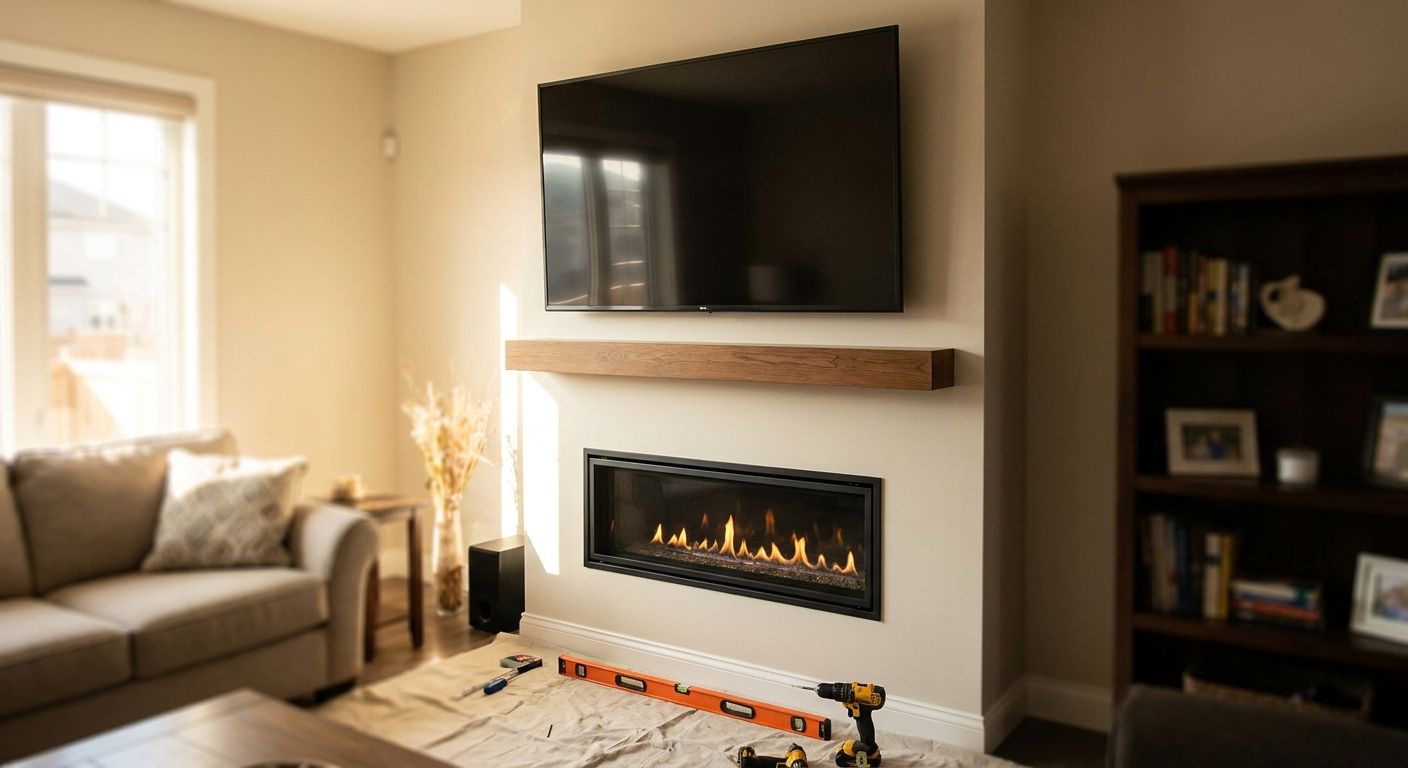
Screens mounted above the bar itself, above a fireplace-style feature wall, or high on a soffit don't need swivel — they need downward tilt so the picture doesn't wash out for anyone standing close. A tilt-only mount sits flatter against the wall than a full-motion arm, which matters when the screen is directly over foot traffic and can't extend far without becoming a hazard.
Most heavy-duty tilt brackets rated for commercial use hold up to 15 degrees of downward tilt, enough to correct glare and viewing angle for anyone standing at the rail below.
Verdict: Buy for any screen mounted above 7 feet where the viewing crowd is directly underneath.
3. Low-profile fixed mount — the wall-to-wall pick
When you're running a row of identical screens across one wall — the classic "wall of games" setup — a fixed low-profile mount keeps every screen flush and perfectly aligned, since there's no arm geometry to introduce inconsistent gaps or tilt drift between units.
The tradeoff is zero adjustability after install, so the mounting height and centerline have to be right the first time. That's a measurement problem, not a mount problem, but it's exactly where DIY installs go wrong on a multi-screen wall.
Verdict: Buy for uniform screen rows; Skip if the wall has mixed screen sizes or uneven seating sightlines.
4. Video wall mount system — the flagship pick
For four or more adjacent screens meant to function as one visual block — common in larger sports bars and in church and event space installations running similar multi-screen layouts — a dedicated video wall mount system with push-to-pop-out latches lets a technician service any single panel without pulling the whole wall apart.
This category costs more per screen than standard full-motion mounts, and it's not worth it below four adjacent panels. Above that, the serviceability pays for itself the first time one screen needs a cable check.
Verdict: Buy for 4+ screen walls; Skip for anything smaller.
5. Outdoor-rated full-motion mount — the patio pick
Any screen on a covered patio, sports bar rooftop, or open-air section needs an outdoor-rated mount with corrosion-resistant hardware, not an indoor mount in a weatherproof box. Standard steel hardware in metro Atlanta's humidity starts showing rust within a single season of exposure.
Verdict: Buy — this is non-negotiable for patio and rooftop screens; there is no acceptable substitute here.
6. Ceiling drop-pole mount — the center-of-room pick
For a screen suspended over a pool table or center bar island with seating on all sides, a ceiling drop-pole mount with a rotating head is the only category that gives 360-degree viewing without a wall behind the screen at all. It's a niche pick — most sports bars need zero or one — but it solves a layout problem no wall mount can touch.
Verdict: Consider if your layout has a true center-of-room viewing zone; otherwise skip it entirely.
“A residential full-motion mount and a commercial full-motion mount can look identical on the shelf and carry a 40-pound gap in rated weight capacity.”
Comparison table
| Mount type | Typical weight rating | Adjustment | Best use | Verdict |
|---|---|---|---|---|
| Full-motion articulating | Up to 100-125 lbs | Swivel + extend | Mixed sightlines, main wall | Buy |
| Heavy-duty tilt | Up to 100+ lbs | 0-15 degrees tilt | Above-bar, high mounts | Buy |
| Low-profile fixed | Up to 100+ lbs | None | Uniform screen rows | Buy / Skip by layout |
| Video wall system | Up to 100+ lbs per panel | Pop-out latch | 4+ screen walls | Buy for 4+ / Skip below |
| Outdoor-rated full-motion | Up to 100 lbs, weatherproof | Swivel + extend | Patio, rooftop, open-air | Buy |
| Ceiling drop-pole | Model-dependent | 360-degree rotate | Center-of-room, pool tables | Consider |
Where to source and install these mounts
- Match the mount rating to the panel, not the screen size alone. A 75-inch commercial display can weigh far more than a consumer 75-inch TV — check the actual product weight, not just the diagonal measurement.
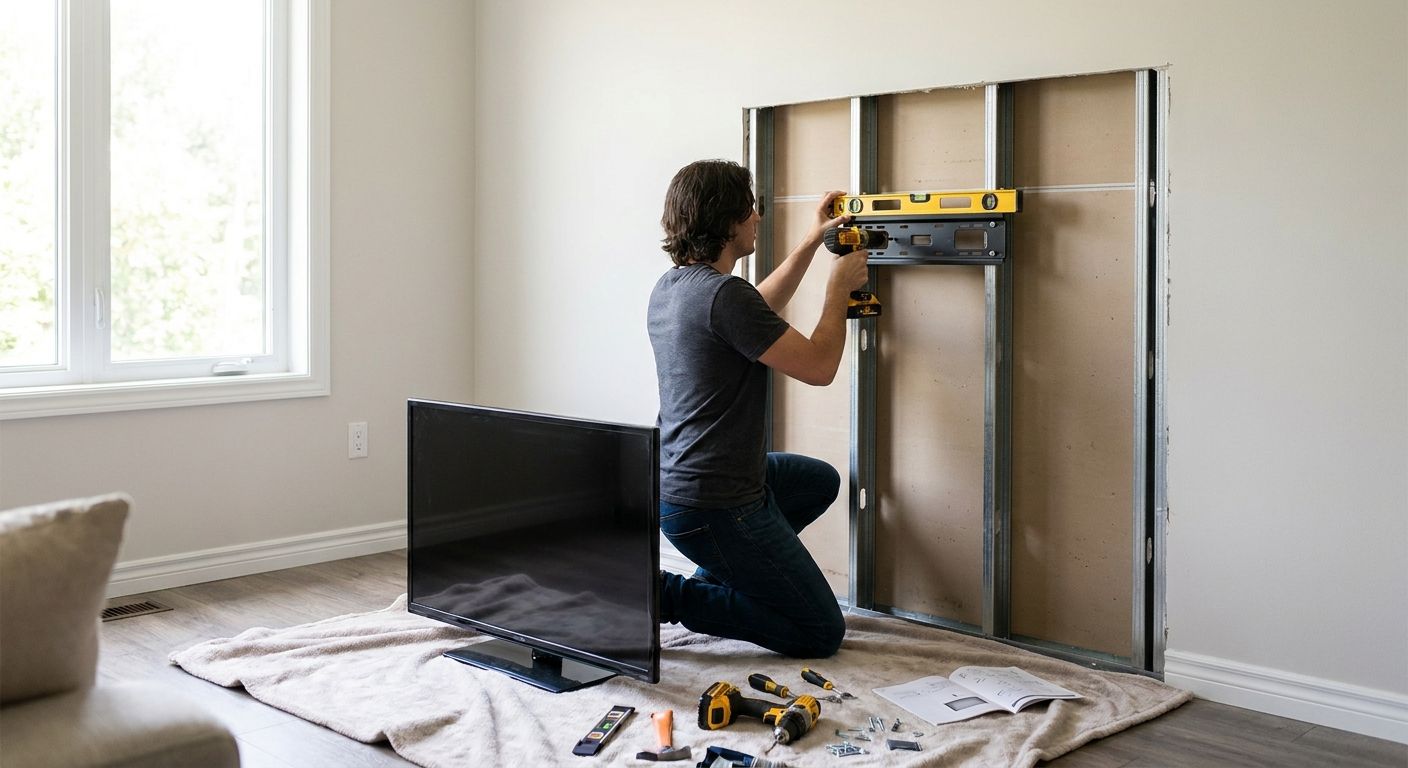
- Confirm the wall substrate before ordering hardware. Drywall-only mounts fail on brick and block walls common in older Atlanta commercial buildings; the anchoring hardware has to match the surface, not just the mount brand.
- Use commercial installation for anything above one or two screens. A single crooked mount is a fix; a crooked six-screen wall is a re-do, and re-dos on commercial walls mean drywall repair the bar owner didn't budget for.
Get your sports bar wall mounted right
Licensed, insured installs backed by a 5-year warranty across metro Atlanta.
FAQ
What are the best tv mounts for sports bar walls in 2026?
Full-motion articulating mounts are the best tv mounts for sports bar walls with mixed sightlines, while heavy-duty tilt mounts win for screens placed above the bar itself. Most sports bars in 2026 run a mix of both across one wall.
How much weight does a commercial TV mount need to hold?
Commercial-grade mounts for 55-to-85-inch sports bar TVs typically need a rating of at least 100 lbs to cover the panel, arm, and hardware combined. Always check the manufacturer's listed weight capacity against the actual TV weight, not just its screen size.
Is a fixed mount or full-motion mount better for a sports bar?
Full-motion mounts are better when seating sightlines vary across the room, since the arm lets one screen serve multiple viewing zones. Fixed mounts work better for uniform rows of identical screens where alignment matters more than adjustability.
Can a regular indoor TV mount go on a covered patio?
No, indoor mounts corrode quickly in outdoor humidity and are not rated for temperature swings or moisture exposure. Any screen on a patio, rooftop, or open-air section needs an outdoor-rated mount with corrosion-resistant hardware.
How many TV mounts does a sports bar need for a video wall?
A dedicated video wall mount system only makes financial sense at four or more adjacent screens meant to function as one visual block. Below that count, standard full-motion or low-profile fixed mounts cover the same screens for less per unit.
Does mounting height matter for sports bar TVs?
Yes, screens mounted above 7 feet with a crowd standing directly underneath need a tilt mount to correct the downward viewing angle. Screens at eye level across a room don't need tilt and are better served by full-motion or fixed mounts.
Should a sports bar hire a professional for multi-screen TV mounting?
Yes, for anything beyond one or two screens, since a misaligned multi-screen wall means costly drywall repair on top of the re-install. Professional installation also confirms the mount rating matches wall substrate and panel weight before anything goes up.
What's the difference between a residential and commercial TV mount?
Commercial mounts carry higher weight ratings and more durable hardware built for repeated adjustment and cleaning in high-traffic venues. A residential mount that looks identical on the shelf can have a 40-pound gap in rated capacity compared to its commercial counterpart.
One last thing
The single most common failure point on a sports bar wall isn't the mount at all — it's the anchor. A $200 full-motion mount rated for 125 lbs is worthless if it's screwed into two drywall anchors instead of studs or a properly rated toggle system, and that mismatch doesn't show up until the wall's been shaking from bass and crowd noise for a few months in 2026.