Metal stud walls behave nothing like wood framing, and the wrong hardware choice on 20-25 gauge steel can mean a 65-inch television pulling loose within months. Here's the ranked breakdown of what actually holds on metal studs in 2026, and when a toggle bolt just isn't enough.
- Toggle anchors alone are fine under roughly 40 lbs, but anything past a 55-inch TV needs direct-to-stud screws or blocking.
- Full-motion arms multiply leverage on metal studs, so mounts over 55 inches need structural screws into at least two studs, not one.
- The best tv mount for metal studs in most metro Atlanta homes in 2026 is a fixed or tilt bracket screwed straight into 20-25 gauge steel, not drywall toggles.
- A 100-inch TV on metal stud drywall almost always needs backer board or a professional install, not off-the-shelf anchors.
Why this matters
Most TV mount hardware sold at big-box stores is designed and tested for wood studs 1.5 inches thick. Metal studs are hollow steel, usually 20 to 25 gauge, spaced 16 or 24 inches on center depending on the build code used when the house or office went up. A wood screw strips the moment it hits steel that thin, and a toggle anchor rated for drywall alone was never meant to carry a 65-inch panel on a full-motion arm.
Get the hardware wrong on metal studs and the failure mode isn't a wobble, it's the bracket tearing through the drywall with the TV attached. That's the reason The TV Mount Men treats metal stud jobs differently from standard wood-frame installs across metro Atlanta — the mounting surface changes the entire hardware plan before the TV size even enters the conversation.
How this list is ranked
Each approach below is ranked by weight capacity relative to the metal stud itself, not by the bracket's advertised rating alone, since most bracket ratings assume wood framing. TV size ranges come from common install patterns seen across residential and commercial jobs — a 32-inch bedroom TV carries different loads than a 100-inch basement setup. Verdicts (Buy, Hold, Wait, Skip) reflect whether the approach is safe to DIY or whether it needs a stud-aware professional install in 2026.
The ranked list
1. Self-tapping metal stud screws with a fixed mount — the budget-safe pick
Fixed mounts hold the TV flat against the wall with zero tilt or swivel, which means almost no leverage stress on the steel stud. Self-tapping screws designed for 20-25 gauge steel bite into the stud directly instead of relying on the drywall's paper facing to hold weight.
This pairing works well for TVs up to about 40 inches, similar to the 40-inch fixed mount installed on drywall in a bedroom in Rockmart, GA. Verdict: Buy for small bedrooms, dorms, and guest rooms where the TV won't be adjusted after install.
2. Toggle anchors with a tilt mount — fine for light-duty, not for heavy glass
Toggle anchors spread load across the back side of the drywall, which helps when a stud isn't positioned where you need it. A tilt bracket adds a small amount of downward leverage that toggle anchors can usually absorb on lighter TVs.
This combination suits TVs in the 32 to 40-inch range, close to the 32-inch fixed mount with a new outlet installed behind the TV in a kids bedroom in Acworth, GA. Push it past 40 inches on metal studs and the anchors start carrying more shear load than they're rated for. Verdict: Hold — fine for light TVs, not a long-term fix for anything larger.
3. Direct-to-stud structural screws for full-motion arms — the mid-weight workhorse
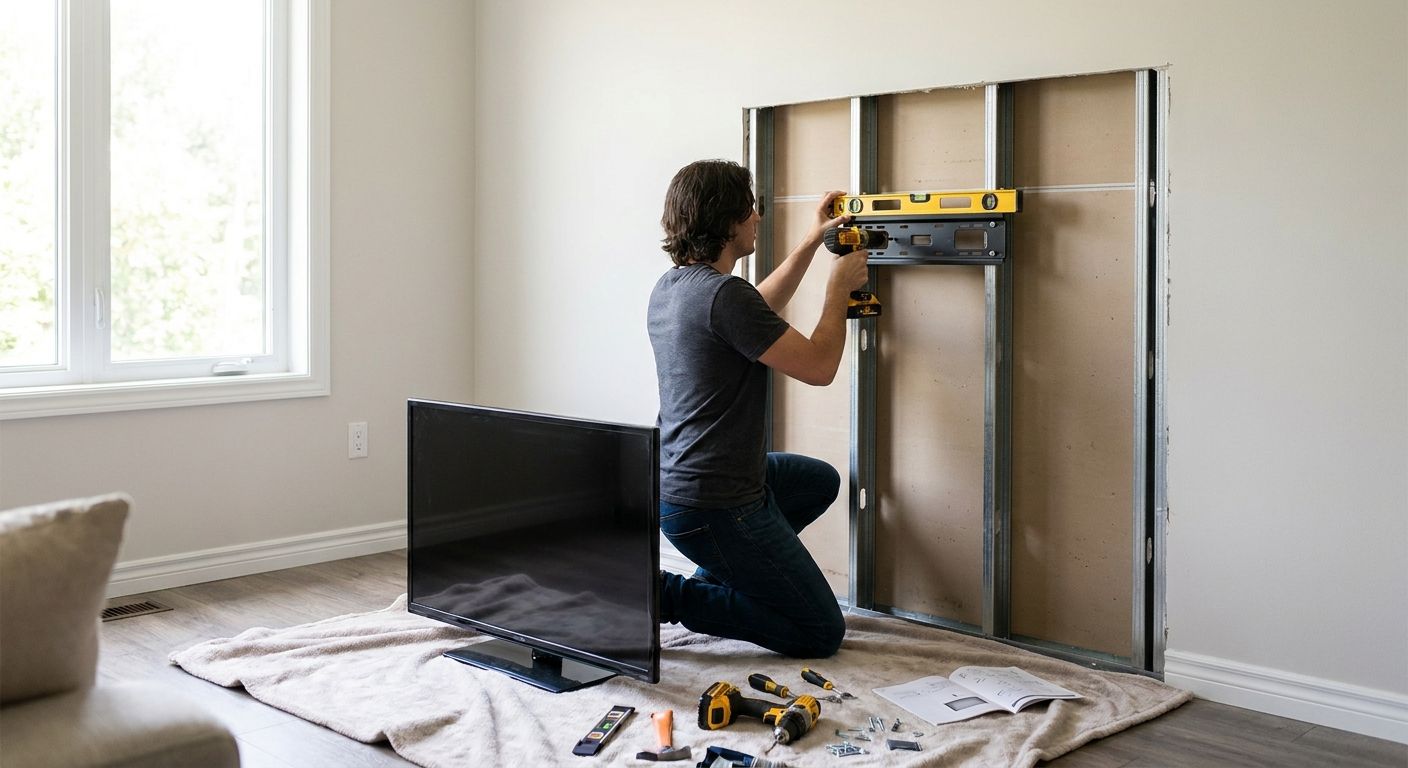
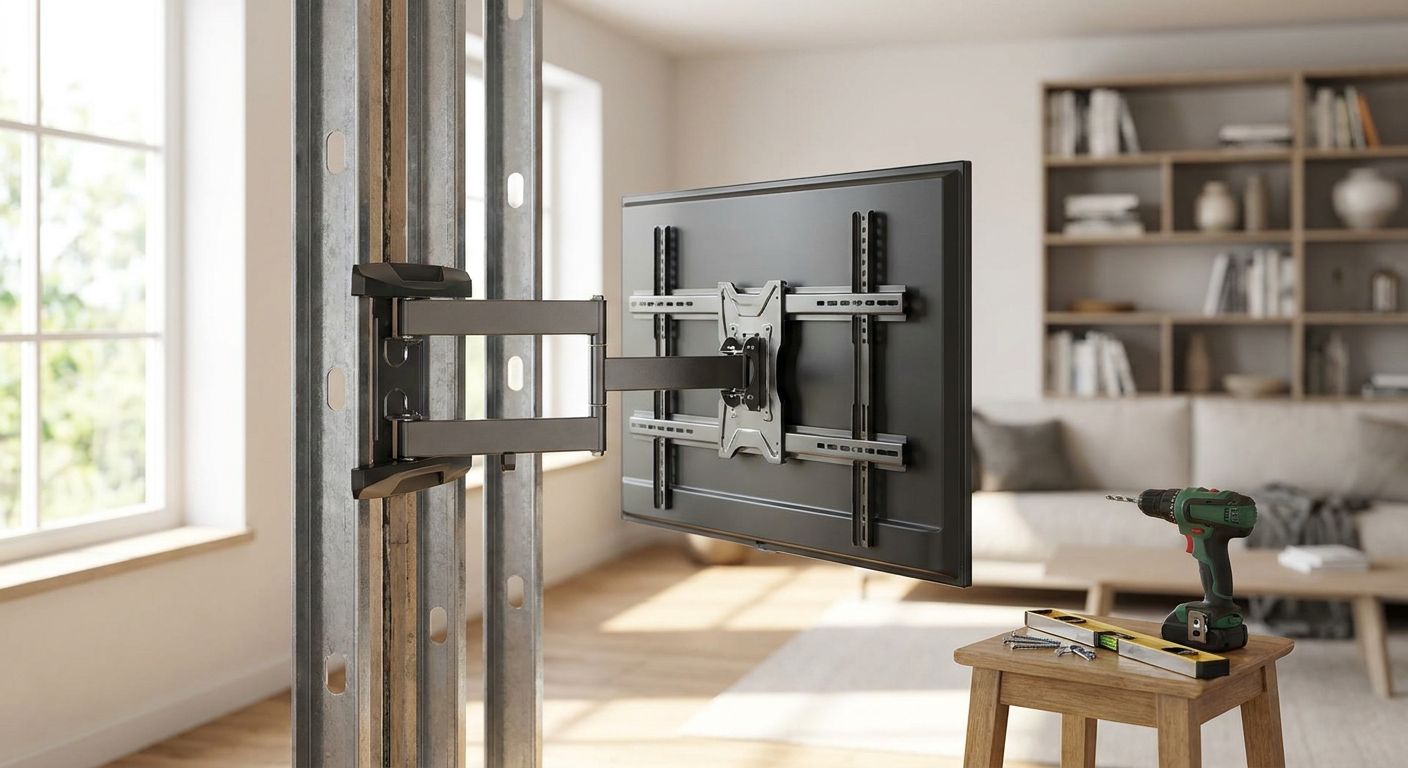
Full-motion arms pull the TV away from the wall, and every inch of extension multiplies the torque on whatever is holding the bracket. On metal studs, that means structural screws driven straight into at least two studs, never a single anchor point.
This is the setup for TVs in the 55 to 75-inch range in living rooms, home theaters, and converted bonus rooms — see how it plays out in a converted garage or bonus room where stud layout is often inconsistent. Verdict: Buy, but only when the mount spans two verified stud locations.
4. Backer board or blocking behind drywall — the heavyweight solution
For anything approaching 90 to 100 inches, metal studs alone usually aren't enough even with structural screws. A plywood backer board spans multiple studs and turns the wall into one continuous anchor point instead of two thin steel rails.
This is exactly the approach behind the 100-inch TV mounted with a heavy-duty tilt bracket on drywall in a Woodstock, GA basement, which also had a new outlet added behind the TV for a cord-free finish. Verdict: Buy for large-format TVs, but plan on professional install — this isn't a weekend DIY job on metal stud walls.
5. Low-profile fixed mounts on metal studs — the space-saver
Low-profile brackets sit closer to the wall, which reduces leverage even further than a standard fixed mount. On metal studs, that lower leverage makes them one of the more forgiving options for smaller rooms where wall space is tight.
This pairs well in tight living rooms and condos — the same logic covered in the guide to low-profile mounts for small living rooms. Verdict: Buy for TVs under 55 inches in space-constrained rooms.
Comparison table
| Approach | Best TV size | Hardware needed | Verdict |
|---|---|---|---|
| Fixed mount + self-tapping stud screws | Up to 40 in | Metal-stud-rated screws | Buy |
| Toggle anchors + tilt mount | 32-40 in | Hollow-wall toggle anchors | Hold |
| Full-motion arm + structural screws | 55-75 in | Screws into 2+ studs | Buy |
| Backer board + heavy-duty tilt bracket | 75-100+ in | Plywood blocking, lag screws | Buy |
| Low-profile fixed mount | Under 55 in | Metal-stud-rated screws | Buy |
On metal stud walls, the weight rating printed on the mount box matters less than whether the screws are actually landing in steel. A bracket rated for 100 lbs on wood framing can fail well below that on 25-gauge steel if the anchors miss the stud entirely.
Where to source hardware and who should install it
- Toggle anchors and metal-stud screws are available at any hardware store, but confirm the gauge rating on the packaging matches 20-25 gauge steel before buying.
- Backer board installs require cutting into drywall, which is where DIY risk goes up fast on metal stud walls — a botched cut can hit wiring or HVAC runs hidden in the stud cavity.
- Full-motion arms on metal studs need a stud finder capable of reading through steel, not the magnetic type built for finding wood-stud nails.
Get your metal stud wall assessed
Confirm the right mount and hardware before you drill.
If the wall in question is textured plaster instead of drywall over metal stud, the hardware calculus changes again — check the breakdown on uneven or textured plaster walls before assuming metal-stud anchors apply.
FAQ
What is the best tv mount for metal studs in 2026?
A fixed or tilt mount installed with self-tapping screws driven directly into 20-25 gauge steel studs is the safest option for most TVs under 55 inches in 2026. Larger TVs need structural screws across two studs or a backer board.
Can you use regular toggle bolts on metal stud walls?
Toggle bolts work on metal stud drywall for lighter TVs, generally up to around 40 inches, but they carry less shear load than screws driven directly into the steel stud. For anything heavier, direct-to-stud hardware is the safer call.
Do you need a stud finder for metal stud walls?
Yes, and it needs to be a model capable of reading through steel rather than a magnetic finder built for wood-stud nails. Metal studs don't give the same signal as wood, so a mismatched tool will miss the stud entirely.
How much weight can a metal stud hold for a TV mount?
It depends on the gauge of the steel and how many studs the mount spans, which is why single-stud toggle anchors aren't reliable past roughly 40 lbs. Spanning two studs with structural screws increases the safe load significantly.
Is a full-motion mount safe on metal stud walls?
Full-motion mounts are safe on metal studs only when the bracket is screwed into at least two stud locations with structural hardware, not a single anchor point. The extension arm multiplies leverage, so a single-point mount is more likely to fail over time.
Do 100-inch TVs need special mounting on metal studs?
Yes, TVs in the 90 to 100-inch range typically need backer board or blocking behind the drywall rather than relying on the metal studs alone. A 100-inch TV mounted on drywall in a Woodstock, GA basement used exactly this approach with a heavy-duty tilt bracket.
Can I mount a TV on metal studs myself?
Fixed mounts under 40 inches on metal studs are reasonable DIY jobs with the right screws, but backer board installs and full-motion arms over 55 inches carry more risk. Cutting into drywall to add blocking can hit wiring hidden in the stud cavity if you're not familiar with the wall.
Does metal stud construction affect where outlets can be added behind a TV?
Yes, adding an outlet behind a mounted TV on a metal stud wall requires working around the stud cavity and any existing wiring runs, similar to the outlet added behind the TV in a kids bedroom install in Acworth, GA. This is typically handled alongside the mounting work, not as a separate step.
One last thing
The detail most DIYers miss on metal stud walls isn't the screw type, it's the stud spacing itself — a full-motion mount rated for two studs at 16 inches on center will not fit the same way on a wall framed at 24 inches on center, and forcing it changes the load path the manufacturer designed for.