Basements and finished lower levels come with wall types, ceiling heights, and humidity levels that don't match the rest of the house, and that changes how a TV mount gets installed. The TV Mount Men handle basement TV mounting across metro Atlanta on block walls, drywall over furring strips, exposed studs, and drop ceilings, with mounting hardware and outlet work matched to each surface.
- Basement TV mounting requires wall-type-specific hardware — block, drywall-on-furring, and stud walls each need different anchors.
- The TV Mount Men rate the drywall-and-outlet combo the safe pick for finished basements: Buy.
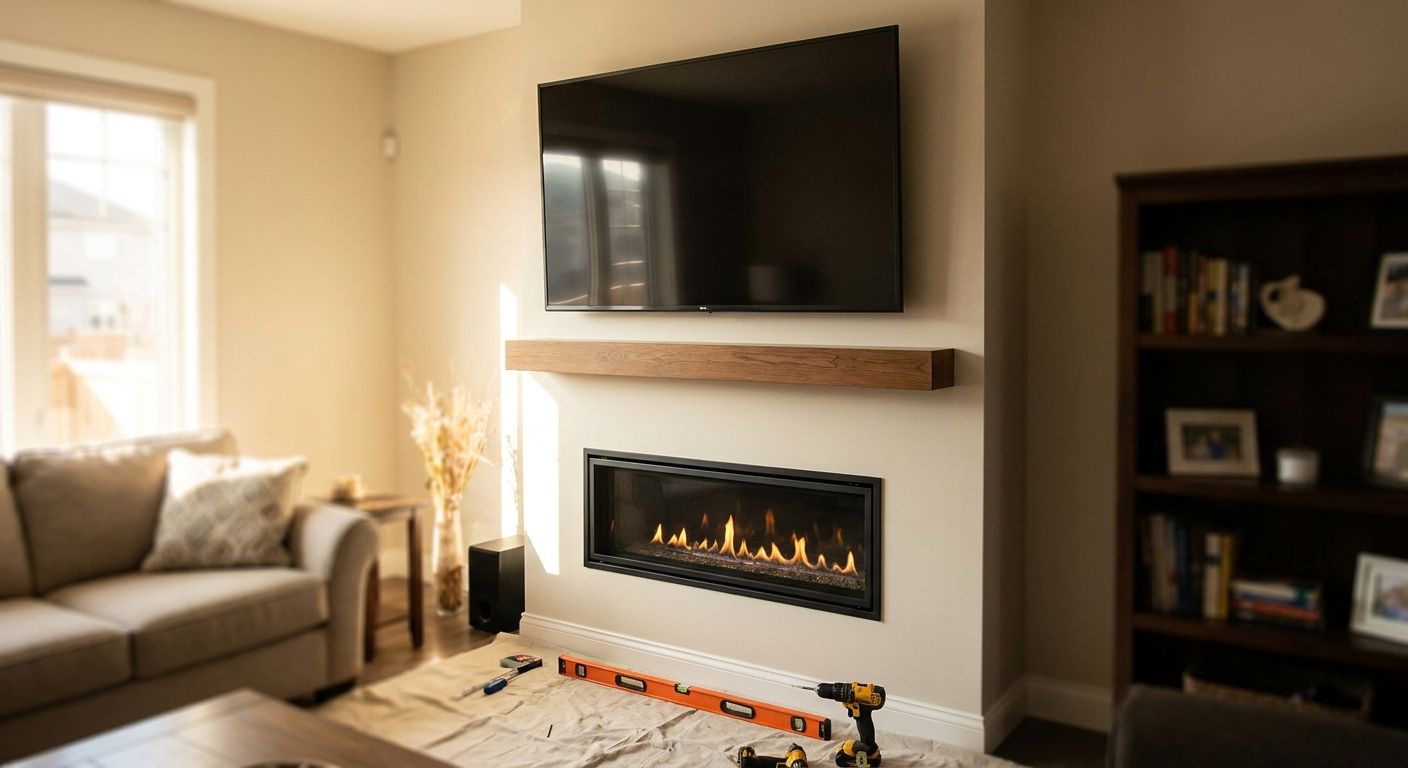
- Above-fireplace and low-ceiling basement mounts need a tilt bracket rated for at least 100 lbs — Consider before DIY.
- Skip standard toggle bolts on cinder block or poured concrete basement walls; they strip out under load.
- Basement home theaters and home gyms both need cord concealment planned before drywall goes back up.
Why this matters
A basement isn't a bedroom with lower ceilings — it's a different structural environment. Poured concrete and cinder block walls don't take drywall anchors, furring-strip drywall has an air gap behind it that swallows standard screws, and moisture from grade level corrodes hardware that would last decades upstairs. Get the wall assessment wrong on a basement TV mount and you end up with a $2,000 theater setup hanging on two anchors rated for a bathroom mirror.
The The TV Mount Men crews working metro Atlanta basements see this constantly in Woodstock, Acworth, and Rockmart homes where the main level is drywall and the finished basement below it is a mix of block, furring strips, and exposed joists. TV mounting for basement spaces gets planned around the wall first, the screen second.
Who this is for
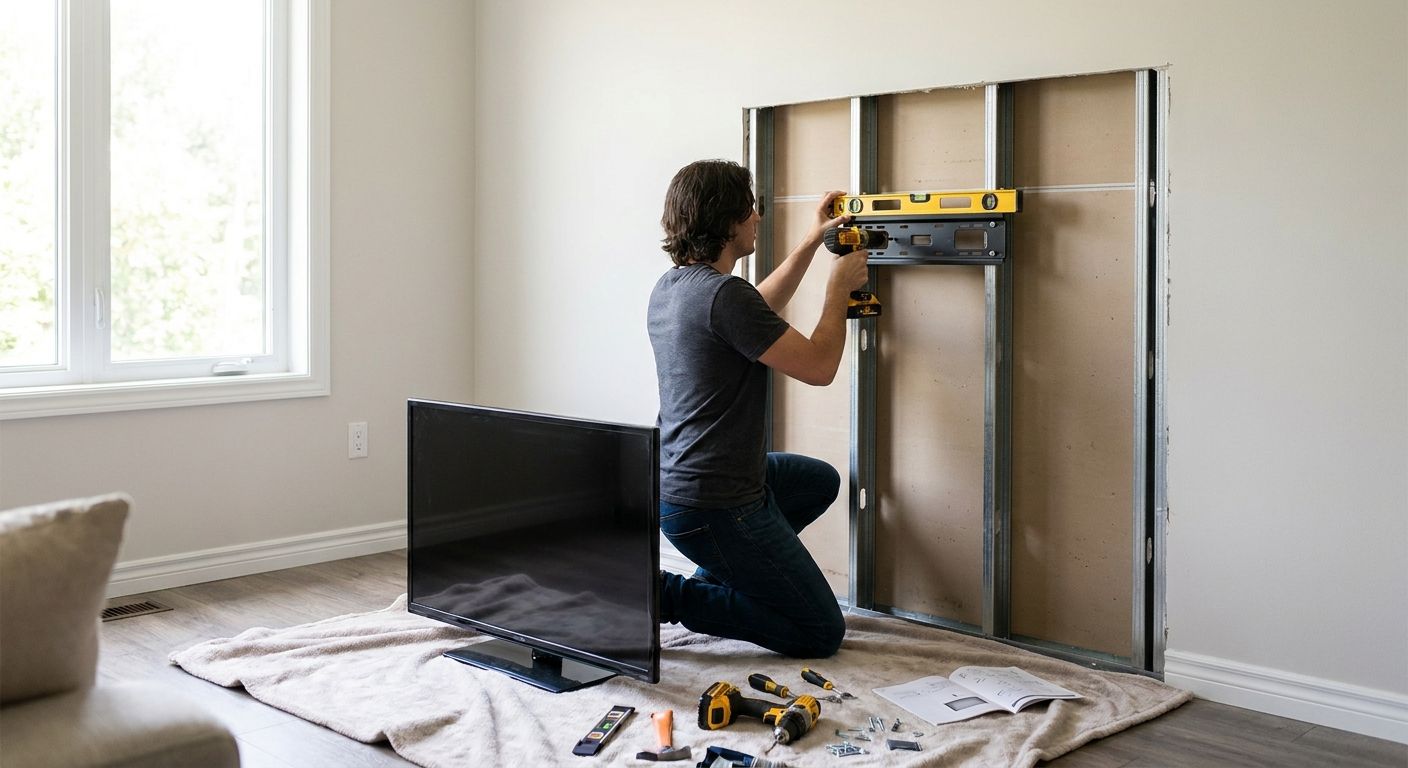
This is for homeowners finishing a basement into a media room, home gym, guest suite, or rental unit, and for anyone staging a finished lower level ahead of a sale. It's also relevant if you're mounting a TV above a basement fireplace or in a low-ceiling mechanical space where a standard fixed bracket won't clear ductwork. If your basement is unfinished block with exposed studs and no drywall yet, the wall assessment below still applies — it just happens before the drywall goes up instead of after.
What to look for in TV mounting for basement rooms
Wall material and anchor type
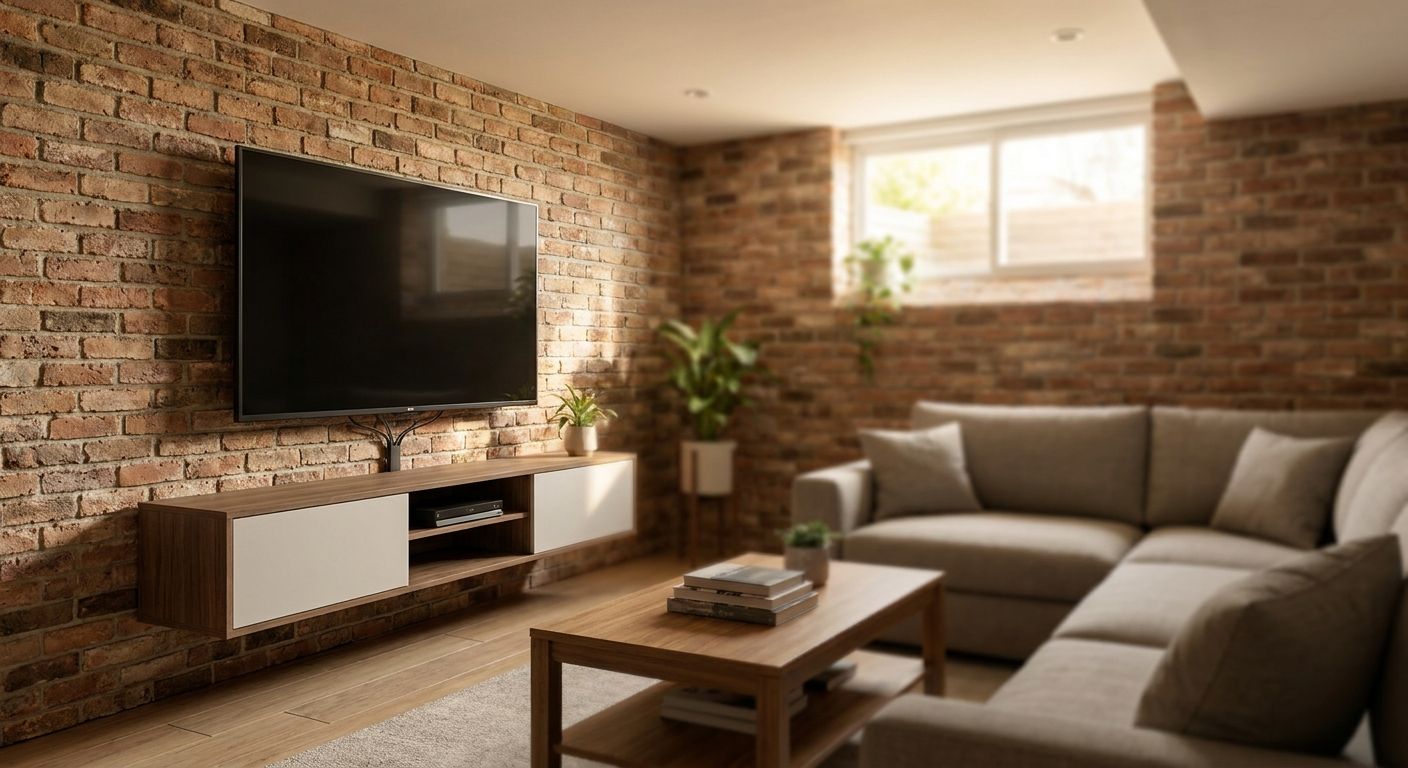
Basement walls are rarely a single material top to bottom. Poured concrete needs concrete screws or sleeve anchors; cinder block needs a different anchor pattern than solid concrete; furring-strip drywall needs the mount anchored into the strips or into masonry behind them, not just the drywall face. Guessing wrong here is the single most common cause of a basement TV falling off the wall within a year.
Ceiling height and joist clearance
Finished basements often drop ceiling height by 8 to 14 inches to make room for ductwork and plumbing, which changes viewing angle math and can put a standard-height mount too close to HVAC returns or sprinkler lines. A tilt bracket set 2 to 4 inches lower than a main-floor install often solves the sightline without touching the ceiling.
Moisture and humidity exposure
Below-grade rooms run higher humidity even with a dehumidifier, and that accelerates corrosion on standard zinc-plated hardware over 3 to 5 years. Stainless or coated anchors cost a few dollars more and are the right call for any basement within 10 feet of an exterior wall.
Outlet and cord routing
A basement wall is usually easier to fish an outlet through than an upstairs wall because there's often unfinished space or a drop ceiling nearby to run conduit. Planning the outlet before the mount goes in means no cord runs down the wall to a floor outlet — a detail that matters more in basements because visible cords read as unfinished in a space you just spent money finishing.
Seating distance and viewing angle
Basement layouts trend toward sectional seating set farther back than a main-floor living room, which pushes toward a larger screen size and a full-motion bracket rather than fixed, especially in an L-shaped or wraparound seating arrangement.
Load rating versus screen size
A 65-inch to 100-inch TV in a basement theater setup needs a bracket rated well above the TV's actual weight — 130 lbs of rated capacity for an 80-lb TV isn't overkill, it's the standard margin for anything mounted into block or furring-strip drywall.
Top picks for basement TV mounting
The home theater pick: fixed or tilt mount with concealed conduit
Built for basements converted into dedicated media rooms with dark walls and stadium or sectional seating. The spec that matters: a tilt bracket rated for 130+ lbs handles screens up to 100 inches without sag over time. The TV Mount Men has run this exact configuration on a 100-inch TV mounted with a heavy-duty tilt bracket on drywall in a Woodstock, GA basement, with a new outlet run behind the TV for a cord-free finish. Verdict: Buy for any basement theater build in 2026.
The workout-room pick: high full-motion mount for gym walls
Basement home gyms need the screen pulled well off the wall and angled toward a rack, treadmill, or mat area rather than a couch. A full-motion arm with 20+ inches of extension gets the screen over equipment without blocking a mirror wall. See how this plays out for TV mounting in basement home gyms. Verdict: Buy if the room is a dedicated workout space; Consider a fixed mount instead if the gym doubles as a guest room.
The staging pick: low-cost fixed mount for resale basements
For a finished basement going on the market, a clean 32 to 55-inch fixed mount reads as a finished amenity without the cost of a full theater build. This mirrors the approach used for TV mounting for real estate staging and open houses, where the goal is a polished look at the lowest reasonable cost. Verdict: Buy ahead of a listing photo shoot; Skip if the basement is unfinished — stage the finished rooms first.
The rental-suite pick: tamper-resistant fixed mount
Basements finished as an in-law suite or short-term rental unit need hardware that won't loosen from repeated use and a mount profile low enough to avoid catching on furniture in a smaller room. This lines up with setups built for TV mounting for apartments and rental properties. Verdict: Consider for a basement rental unit; Buy if the unit is already leased and tenants are moving in within 2026.
What to avoid
- Standard drywall toggle anchors on block or poured concrete. They look identical to concrete anchors in the hardware bin but strip out under 40 to 60 lbs of load — well under most TV weights.
- Skipping the moisture check on exterior-facing basement walls. A wall that feels dry in October can sweat in July; corrosion on hardware isn't visible until the mount fails.
- Mounting before the outlet is planned. Once drywall is finished and painted, adding a recessed outlet behind the TV means cutting into a wall you just paid to finish — plan the electrical work before the mount goes in, not after.
The same wall-assessment discipline applies outside the basement. Anyone converting a garage space into a home gym runs into the identical problem — a wall that looks straightforward until you're 20 minutes into the install and hit block instead of drywall — which is exactly why that assessment step comes first regardless of which below-grade or garage room is getting finished.
Get a basement wall assessed
Metro Atlanta scheduling for block, drywall, and furring-strip basement walls.
Verdict comparison table
| Setup | Best wall type | Screen size range | Verdict |
|---|---|---|---|
| Home theater tilt mount | Drywall over furring, block | 65"-100" | Buy |
| Home gym full-motion arm | Drywall, block | 43"-65" | Buy |
| Staging fixed mount | Drywall | 32"-55" | Buy pre-listing |
| Rental-suite fixed mount | Drywall, stud wall | 40"-55" | Consider |
FAQ
What's the best TV mount for a basement wall?
A tilt or full-motion bracket rated for at least 130 lbs works best because most basement walls are block, poured concrete, or drywall over furring strips, all of which need a higher hardware margin than standard drywall. The right anchor type depends on which of those three the wall actually is.
Is TV mounting for basement walls different from upstairs rooms?
Yes — basement walls are commonly block, poured concrete, or furring-strip drywall rather than standard stud drywall, which changes the anchor type entirely. Moisture exposure below grade also pushes toward corrosion-resistant hardware that isn't necessary on a main-floor install.
Can you mount a TV on a cinder block basement wall?
Yes, with sleeve anchors or concrete screws rated for block rather than standard drywall toggles. Standard anchors strip out of block under normal TV weight within months.
How much does basement TV mounting cost in 2026?
Cost depends on wall type, TV size, and whether a new outlet is added behind the mount, since block and furring-strip walls take longer to anchor than standard drywall. Get a quote based on the specific wall and screen size for an accurate 2026 number.
Should a basement TV mount be fixed or full-motion?
Full-motion suits basements with sectional or wraparound seating where the viewing angle changes by seat; fixed mounts suit smaller basement bedrooms, staging setups, or rental suites with a single seating direction.
Do basement TVs need a moisture-resistant mount?
Any basement wall within about 10 feet of an exterior foundation wall benefits from stainless or coated hardware, since standard zinc-plated anchors corrode faster in below-grade humidity over 3 to 5 years.
Can a TV be mounted above a basement fireplace?
Yes, with a tilt bracket set to angle the screen down toward seating and cord concealment run through the wall or a nearby chase, the same approach used for above-fireplace installs on other floors.
What size TV fits a basement home theater?
65 to 100 inches is typical for a dedicated basement theater room with seating set 8 to 12 feet back, while 43 to 55 inches suits a basement home gym or smaller media nook.
One last thing
The detail homeowners miss most in 2026 basement finishes isn't the bracket — it's the outlet. A basement TV mounted before the electrical rough-in gets a cord running down a freshly painted wall to the nearest floor outlet, and by the time anyone notices, the drywall is closed up and fixing it means cutting back into finished work.