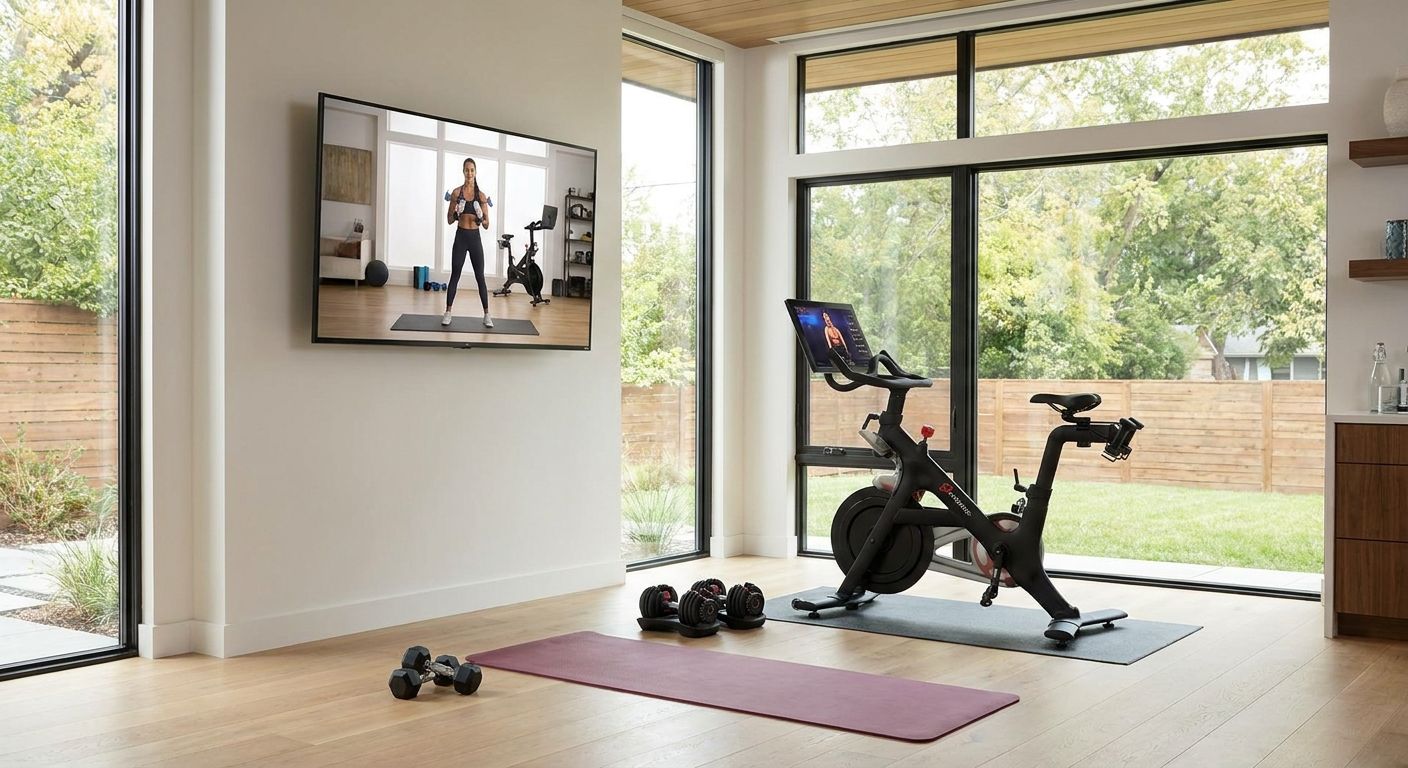
Setting up a home gym TV means solving problems a living room mount never faces: sweat, vibration from treadmills and rowers, sightlines from 10-15 feet away, and walls that are often unfinished garage drywall or exposed brick. The right mount and height decision changes whether you can actually see the screen mid-set or squint through a workout.
- Full-motion tilt mounts win for home gyms with cardio equipment set back 8-12 feet from the wall.
- TV mounting for home gym setups needs eye-level placement between 42 and 50 inches to center, not standard living-room height.
- Fixed mounts save 1.2 inches of wall clearance but fail in gyms with treadmills or bikes facing the screen at an angle.
- Exposed brick or block walls in garage gyms need masonry anchors, not standard drywall toggles.
- The TV Mount Men has completed 10,000+ installations across metro Atlanta with a 5-year warranty on mount hardware.
Why this matters
A TV mounted for a couch 8 feet away is wrong for a treadmill facing a wall 11 feet away, and it's wrong again if that same TV needs to tilt down 15 degrees for someone on a floor mat. Home gym owners in 2026 are adding screens for streaming classes, form-check mirroring, and sports on the bike, and most are retrofitting a garage, basement, or spare bedroom that wasn't built with a media wall in mind.
Get the mount type and height wrong and you're either re-drilling holes in drywall or living with neck strain every session. TV mounting services across metro Atlanta cover exactly this kind of non-standard install, from unfinished garage studs to exposed brick basement walls.
Who this is for
This guide is for anyone converting a garage, basement, or spare room into a home gym and needs a TV visible from cardio equipment, a lifting platform, or a stretching mat, not a couch. It's built around Atlanta-area setups where wall type, humidity, and sightline distance vary more than in a typical living room, and where the wrong bracket means re-patching drywall six months later.
What to look for in TV mounting for a home gym
Viewing distance and mount articulation
A treadmill or rower usually sits 8 to 12 feet from the wall, farther than a typical couch distance of 6 to 9 feet. At that range a 55-inch screen reads clearly, but anything closer than 8 feet on a 65-inch or larger TV forces you to turn your head to catch the full frame. Full-motion mounts let you swing the screen toward the equipment instead of centering it on the wall, which matters when gym layouts rarely line up equipment dead-center.
Tilt angle for elevated or floor-level viewing
Mounting height in a home gym is dictated by the equipment, not the room. A TV centered for someone standing on a treadmill needs roughly 8 to 12 degrees of downward tilt if it's above eye level, and a mount with 0 degrees of tilt creates glare and neck strain during a 30-45 minute cardio session.
Wall type and anchor strength
Garage and basement gym walls are inconsistent: some are finished drywall over 16-inch stud spacing, some are unfinished studs, and some are exposed brick, block, or poured concrete. A standard drywall toggle bolt rated for 50-75 lbs is fine for a 43-inch TV but undersized for a 65-inch-plus screen on a full-motion arm, which puts leverage-driven stress on the anchor every time the arm extends.
Cable management and outlet placement
Gyms with exposed conduit, resistance bands, or floor mats need cords tucked completely out of the way, not just bundled. Running power through the wall to a new outlet behind the TV eliminates the trip hazard a visible cord creates next to a treadmill or free weights.
Humidity and heat tolerance
Unconditioned garages in Georgia summers regularly hit 90-100 degrees and high humidity, conditions that stress both the TV panel and adhesive-backed cable channels. A mount and cable setup rated for garage conditions holds up longer than a living-room-grade install dropped into a hot, humid space.
TV size relative to room depth
A 43-inch TV in a room with 12 feet of viewing distance looks undersized and hard to read mid-set. Matching screen size to the actual distance from equipment to wall, not the size of the room, keeps text and interval timers legible during a workout.
Top mounting setups for home gyms
The safe pick: full-motion articulating mount. Rated for VESA patterns up to 600x400mm and weight capacities around 80-100 lbs, this setup lets the screen swing 90 degrees toward a treadmill or bike positioned off-center. It's the right call for any gym where equipment doesn't sit dead-center on the wall. Buy.
The wildcard: ceiling-drop mount for mirrored studios. In garage gyms with mirrored walls floor to ceiling, a drop-pole mount extending 24-48 inches from the ceiling clears the mirror surface entirely and keeps the wall free for wall-mounted equipment racks. It costs more in labor than a wall mount but solves a layout problem a wall bracket can't. Consider.
The budget pick: fixed low-profile mount. Sitting within 1.2 inches of the wall, a fixed mount is the cheapest option and looks cleanest, but it locks the TV at a single angle. Fine for a small home gym where the screen sits directly across from equipment; a poor choice anywhere the viewing angle shifts by more than 15-20 degrees. Consider for tight, single-angle rooms; Skip for wide or angled layouts.
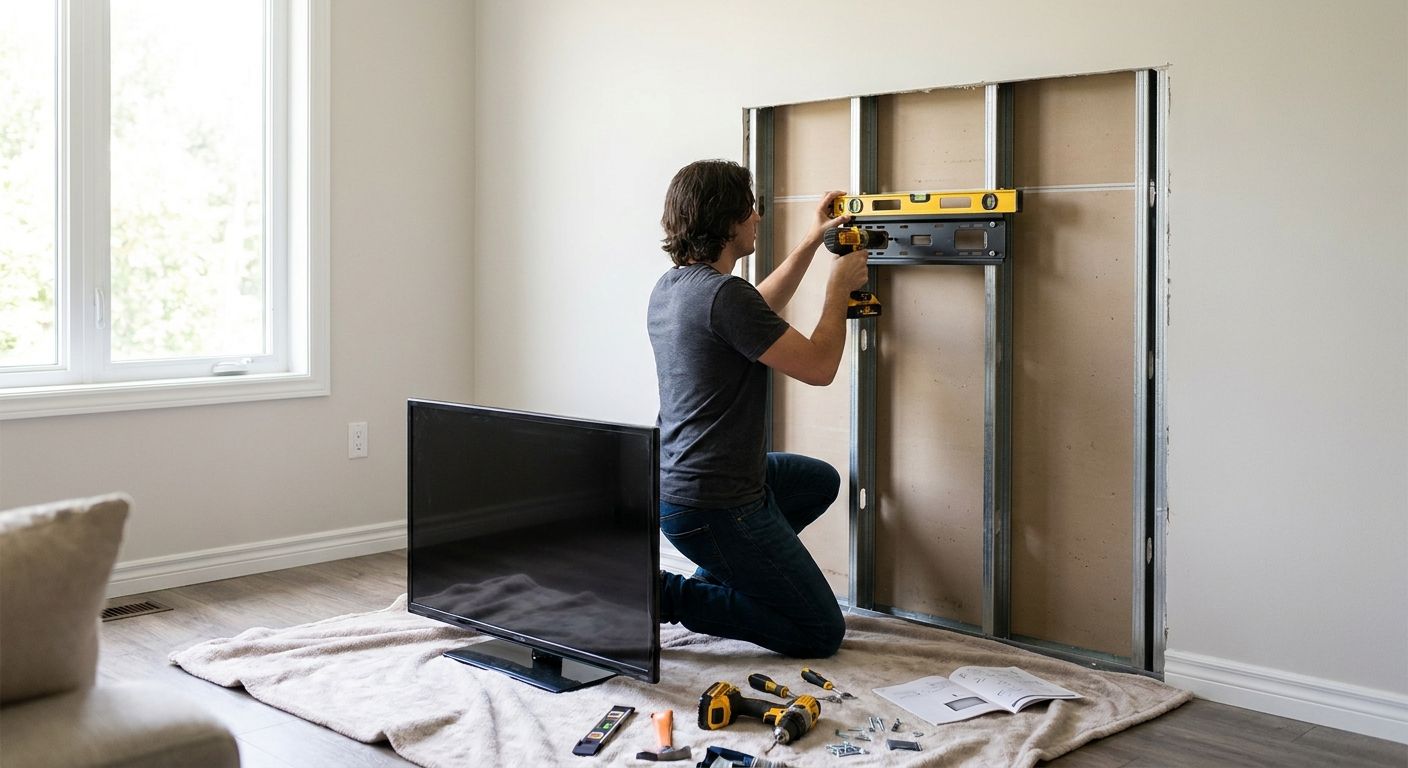
The exposed-brick pick: masonry-anchored mount. Basement and garage gyms with exposed brick or block walls need mounts secured with masonry anchors rated for lateral pull, not drywall hardware. The process and hardware differ enough from a standard drywall install that it's worth reviewing a dedicated guide on mounting over brick before attempting it. Buy, with the correct anchors.
Get a home gym TV mounting quote
Licensed, insured installers serving metro Atlanta gyms and garages.
What to avoid
- Standard living-room height charts. A height calculator built for a seated couch viewer puts the screen too low for someone standing on a treadmill or elevated on a platform.
- Drywall-only anchors on 65-inch-plus TVs with full-motion arms. The extended arm multiplies leverage on the anchor point; undersized hardware here is the most common failure point in DIY gym installs.
- Adhesive cable channels in unconditioned garages. Heat cycling in a Georgia garage through summer 2026 breaks down adhesive backing faster than in a climate-controlled room, and cords end up sagging into equipment paths within months.
Verdict comparison table
| Setup | Best viewing distance | Weight capacity | Best wall type | Verdict |
|---|---|---|---|---|
| Full-motion articulating mount | 8-12 ft, off-center | ~80-100 lbs | Drywall on studs | Buy |
| Ceiling-drop mount | 10-15 ft, mirrored rooms | Varies by pole rating | Ceiling joists | Consider |
| Fixed low-profile mount | 8-10 ft, centered | ~50-75 lbs | Drywall on studs | Consider (narrow layouts) |
| Masonry-anchored mount | 8-12 ft | Rated per anchor type | Brick, block, concrete | Buy (with correct anchors) |
FAQ
What's the best TV mount for a home gym?
A full-motion articulating mount is the best TV mount for a home gym because it swings the screen toward off-center equipment like a treadmill or bike. Fixed mounts only work well when the equipment sits directly across from the wall.
How high should a TV be mounted in a home gym?
Center the TV between 42 and 50 inches from the floor for standing equipment like treadmills, adjusting up or down based on the specific machine's display height. Standard living-room height charts built for seated couch viewing sit too low for a standing workout.
Can you mount a TV on an exposed brick wall in a garage gym?
Yes, but it requires masonry anchors rated for lateral pull instead of standard drywall hardware. The drilling process and anchor spacing differ enough from drywall installs that following a brick-specific mounting guide prevents a failed anchor.
Do TVs need to be rated for garage or basement humidity?
Standard TVs aren't built for high humidity or temperature swings above 90-100 degrees, which unconditioned Georgia garages regularly hit in summer. Ventilation and keeping the TV off a wall that gets direct heat exposure matters more than any special TV rating.
Is a fixed mount or full-motion mount better for a home gym?
Full-motion mounts are better for most home gyms because equipment rarely sits dead-center on the wall. Fixed mounts only make sense in small rooms where the viewing angle never changes.
How far should a home gym TV be from a treadmill?
Most treadmills and rowers sit 8 to 12 feet from the wall, which supports a 55-inch to 65-inch screen comfortably. Closer than 8 feet on a 65-inch or larger screen forces the viewer to turn their head to see the full frame.
Should I run a new outlet behind a home gym TV?
Running a dedicated outlet behind the TV eliminates a visible cord running across a floor near a treadmill, bike, or free weights, which is a real trip hazard in a gym setting. It also gives a cleaner finish than surface-mounted cable channels alone.
One last thing
The detail most home gym owners skip is tilt angle relative to standing height, not screen size. A TV sized correctly for the room but hung with zero tilt above eye level creates neck strain over a 30-45 minute session in a way a slightly smaller, properly angled screen never does. Get the tilt right first, then size the screen to the distance.
The TV Mount Men has handled this exact mismatch on 10,000+ installations across metro Atlanta by 2026, backed by a 5-year warranty on mount hardware and over 300 five-star reviews from customers who needed a non-standard wall solved right the first time.