An accessory dwelling unit or in-law suite runs 400 to 900 square feet on average, which means every design choice — including where the TV goes — has less room for error than in a full-size house. TV mounting for an ADU has to account for tighter walls, shared electrical panels, and often a different resident (an aging parent, a renter, an adult child) than the main house.
- Fixed low-profile mounts are the safe call for basement and garage-converted ADUs under 600 square feet.
- Full-motion tilt mounts at 42-48 inches center height work best for in-law suites housing older residents.
- Skip flush no-gap mounts in rental ADUs — they block access to cable and streaming box ports.
- The TV Mount Men installs on drywall, brick, and metal-stud ADU walls across metro Atlanta with a 5-year warranty.
Why this matters
ADU construction in Georgia has picked up since local zoning changes made backyard cottages and garage conversions easier to permit, and most of these units get built with thinner interior walls than the primary residence. A mount rated for standard 2x4 drywall construction can still fail on a garage-converted ADU where studs sit behind furring strips instead of load-bearing framing. Getting the wall type, mount type, and outlet plan right the first time avoids a redo six months later when the bracket starts sagging.
Who this is for
This guide is for homeowners finishing a basement, garage, or backyard structure into a livable ADU, and for families setting up an in-law suite for a parent or relative. It also applies if the unit will double as a short-term or long-term rental. The TV Mount Men has handled all three scenarios across metro Atlanta — from a 100-inch drywall install in a Woodstock basement to compact bedroom mounts in Acworth and Rockmart — and the wall type, not the square footage, usually decides which bracket works.
What to look for in TV mounting for ADUs and in-law suites
Wall construction behind the mount
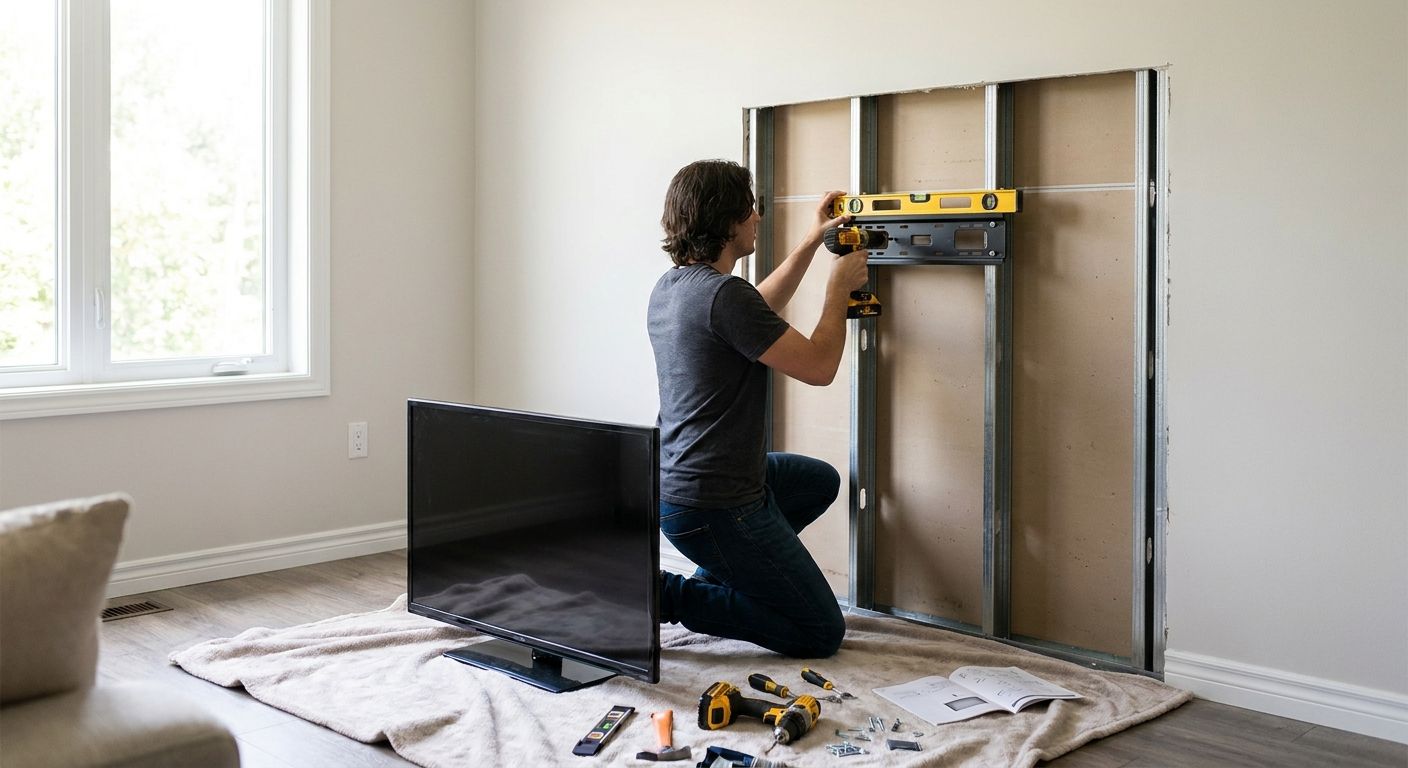
Garage conversions and backyard ADUs often use furring strips over concrete block or metal studs instead of standard 16-inch-on-center wood framing. A bracket rated for wood studs will pull loose from a metal stud wall inside a year without the right toggle anchors or a plywood backer board. Confirm wall type before picking a mount, not after it's already on the wall.
Available space and viewing distance
Most ADU living areas put the couch 6 to 9 feet from the TV wall, which is closer than a typical living room. A 55-inch TV at that distance needs a mount that lets you adjust the tilt angle down, since ceiling height in converted garages and basements tends to run lower than the main house.
Outlet and cable placement
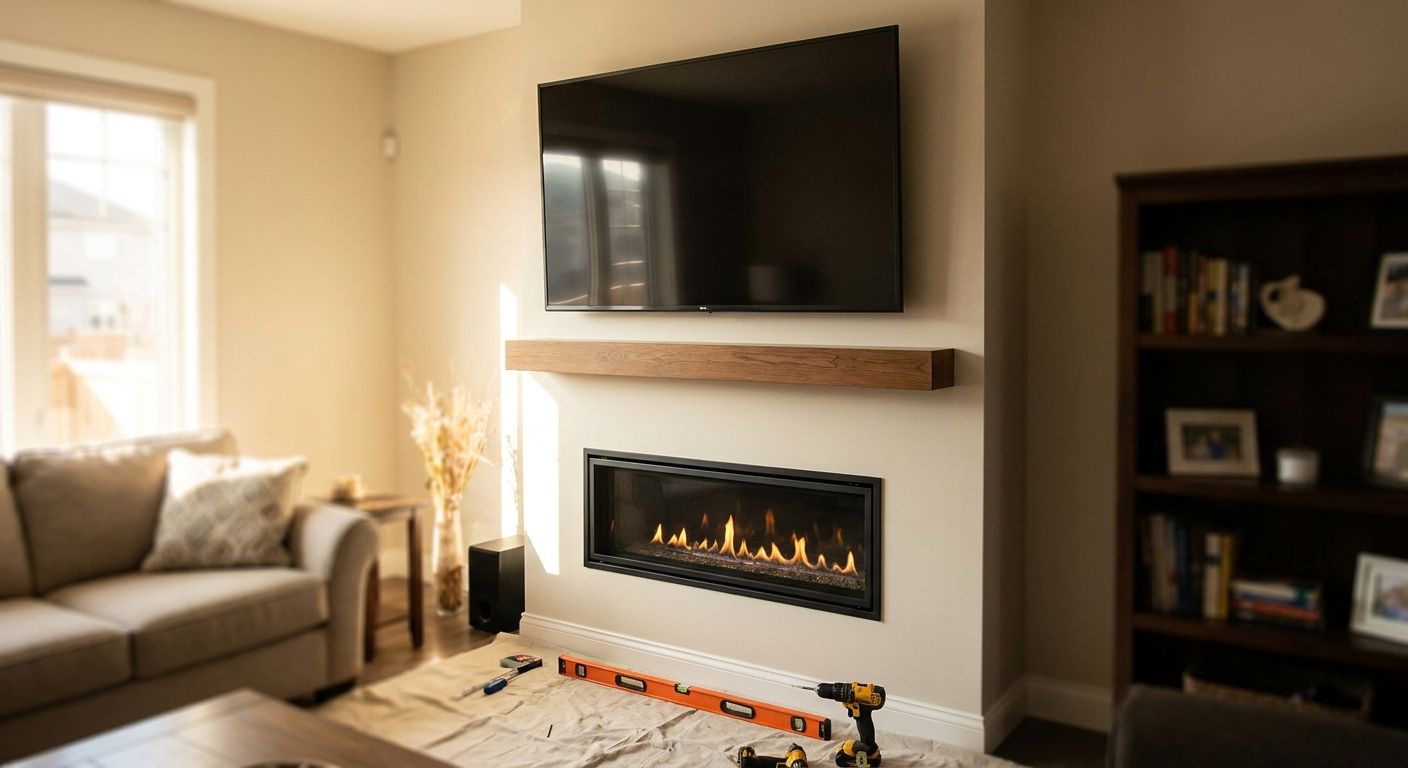
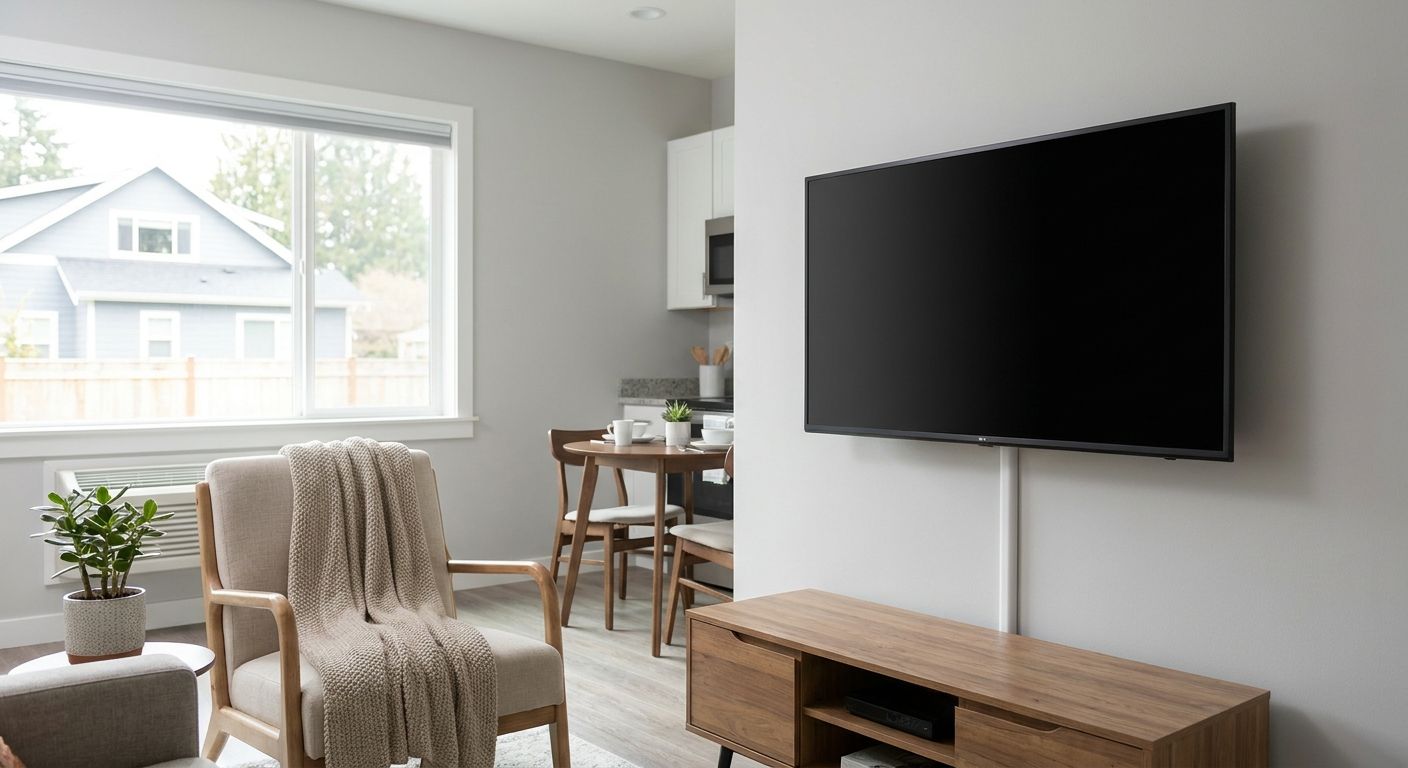
A finished ADU should never show a cord running down the wall to a floor outlet ten feet away — it looks unfinished and it's a tripping hazard in a small footprint. An in-wall power kit or a new outlet installed directly behind the TV keeps the whole setup cord-free, the same approach used on a recent Acworth, GA kids bedroom install with a new outlet added behind a 32-inch fixed mount.
Accessibility for in-law suite residents
If the ADU houses an aging parent or a resident with mobility limits, mount height and viewing angle matter more than screen size. A full-motion mount that tilts down 15 degrees compensates for a lower seated eye line in a recliner, and centering the screen at 42 inches from the floor works better than the standard 60-inch "eye level" guideline used in living rooms.
Durability if the unit is a rental
An ADU used as a long-term or short-term rental gets less careful handling than an owner-occupied space. Fixed mounts with locking brackets hold up better than tilt or full-motion arms that guests can bump loose, and a tamper-resistant mount plate cuts down on service calls between tenants.
Get an ADU mount quote today
Licensed, insured installs across metro Atlanta with a 5-year warranty.
Top picks for ADU and in-law suite mounting
The safe pick: fixed mount for a basement ADU
A basement-converted ADU typically has finished drywall over standard framing, which makes it the easiest wall type to mount into. A fixed low-profile mount holds the TV within 1.5 inches of the wall, which matters in a basement where ceiling height already runs shorter than the main floor. This matches the kind of drywall install TV Mount Men has completed on basement TV setups across the metro, including the 100-inch Woodstock, GA build with a new outlet run behind the screen. Verdict: Buy for any basement ADU with standard drywall and adequate stud spacing.
The accessibility pick: full-motion mount for an in-law suite
When the ADU houses a parent or older relative, a full-motion arm that extends 16 to 20 inches from the wall and tilts down lets the resident adjust the screen from a recliner or wheelchair without asking for help. This is the setup detailed on TV Mount Men's senior living and accessibility guide, which covers lower mount heights and easier-reach cable access. Verdict: Buy for any in-law suite housing a resident with limited mobility.
The rental-ready pick: locking fixed mount for a rental ADU
An ADU rented out short-term or long-term needs a bracket that a guest can't knock loose or tilt out of alignment between bookings. A locking fixed mount keeps the screen flush and secure, the same durability standard covered in TV Mount Men's apartment and rental property mounting guide. Verdict: Buy if the ADU is generating rental income; Consider a tilt mount instead only if the unit is owner-occupied.
The wildcard: articulating mount for a multi-use ADU
Some ADUs double as a home office by day and a guest suite by night, which calls for a mount that swivels toward a desk chair in one position and a bed in another. An articulating arm with a 180-degree swing handles both, but it costs more in labor because it needs a stronger backer board behind thin ADU drywall. Verdict: Consider only if the space genuinely serves two functions — otherwise a fixed mount does the job for less.
What to avoid
- Adhesive or drywall-anchor-only mounts on furring-strip walls. They hold for a few weeks, then the TV tilts forward as the anchors work loose from the thin backing.
- Full-motion arms in units under 500 square feet. The extended arm eats into already-tight floor clearance and becomes a bump hazard in a small in-law suite.
- Skipping the outlet relocation. A visible power cord running to a distant outlet undercuts the finished look of an ADU that's supposed to add resale or rental value.
Comparison at a glance
| Scenario | Mount Type | Typical Wall | Height Guidance | Verdict |
|---|---|---|---|---|
| Basement ADU | Fixed, low-profile | Drywall over standard studs | 60 in. to center | Buy |
| In-law suite (accessibility) | Full-motion, tilt | Drywall or furring strip | 42-48 in. to center | Buy |
| Rental ADU | Fixed, locking plate | Drywall or block | 55-60 in. to center | Buy |
| Multi-use ADU/office | Articulating, 180° swing | Reinforced drywall | 48-54 in. to center | Consider |
| Garage-converted ADU | Heavy-duty fixed with backer board | Furring strip over block | 55-60 in. to center | Consider |
FAQ
What is TV mounting for an ADU or in-law suite?
It's a wall mount installation sized and positioned for the smaller footprint and different wall construction typical of accessory dwelling units and in-law suites. The mount type and height usually differ from a main-house installation because of tighter viewing distances and, in many cases, an older or less mobile resident.
How high should a TV be mounted in a small ADU?
Most ADU living areas mount the center of the screen around 55 to 60 inches from the floor, but in-law suites with a seated or reclined viewer often work better at 42 to 48 inches. The right height depends on seating position more than room size.
Is a full-motion mount better than fixed for an in-law suite?
A full-motion mount is generally better when the resident needs to adjust viewing angle from a recliner or wheelchair. For a standard seating arrangement, a fixed mount is simpler and costs less to install.
Can you mount a TV on drywall without hitting a stud in a garage-converted ADU?
Garage conversions often use furring strips instead of standard studs, so a toggle-anchor system or a plywood backer board is usually needed instead of a stud-only mount. Confirming wall construction before installation avoids a bracket that pulls loose within months.
How much does TV mounting cost for an ADU in metro Atlanta?
Pricing depends on mount type, wall material, and whether a new outlet needs to be run behind the TV. Get an exact quote based on the specific ADU wall type and screen size.
Do accessory dwelling units need extra outlets for TV mounting?
Most ADUs benefit from a dedicated outlet installed behind the TV rather than running a cord to an existing outlet across the room. This keeps the small footprint of an ADU looking finished instead of cluttered with visible cabling.
Is TV mounting a good idea for an ADU used as a rental?
Yes, a locking fixed mount holds up well to guest turnover and reduces service calls compared to a full-motion arm that can be knocked loose. It also protects the TV from tipping in a smaller, more heavily trafficked space.
How long does TV mounting take in an ADU?
A standard fixed-mount install on drywall typically takes under an hour once the wall type is confirmed. Jobs that require a new outlet, a backer board for furring-strip walls, or cable concealment take longer.
One last thing
The detail most ADU owners miss isn't the mount — it's the wall behind it. A garage conversion or backyard structure built with furring strips over block needs a backer board or heavy-duty toggle anchors, not the same hardware that works fine on standard drywall in the main house; skipping that step is the single most common reason a mount fails within the first year in a converted space.