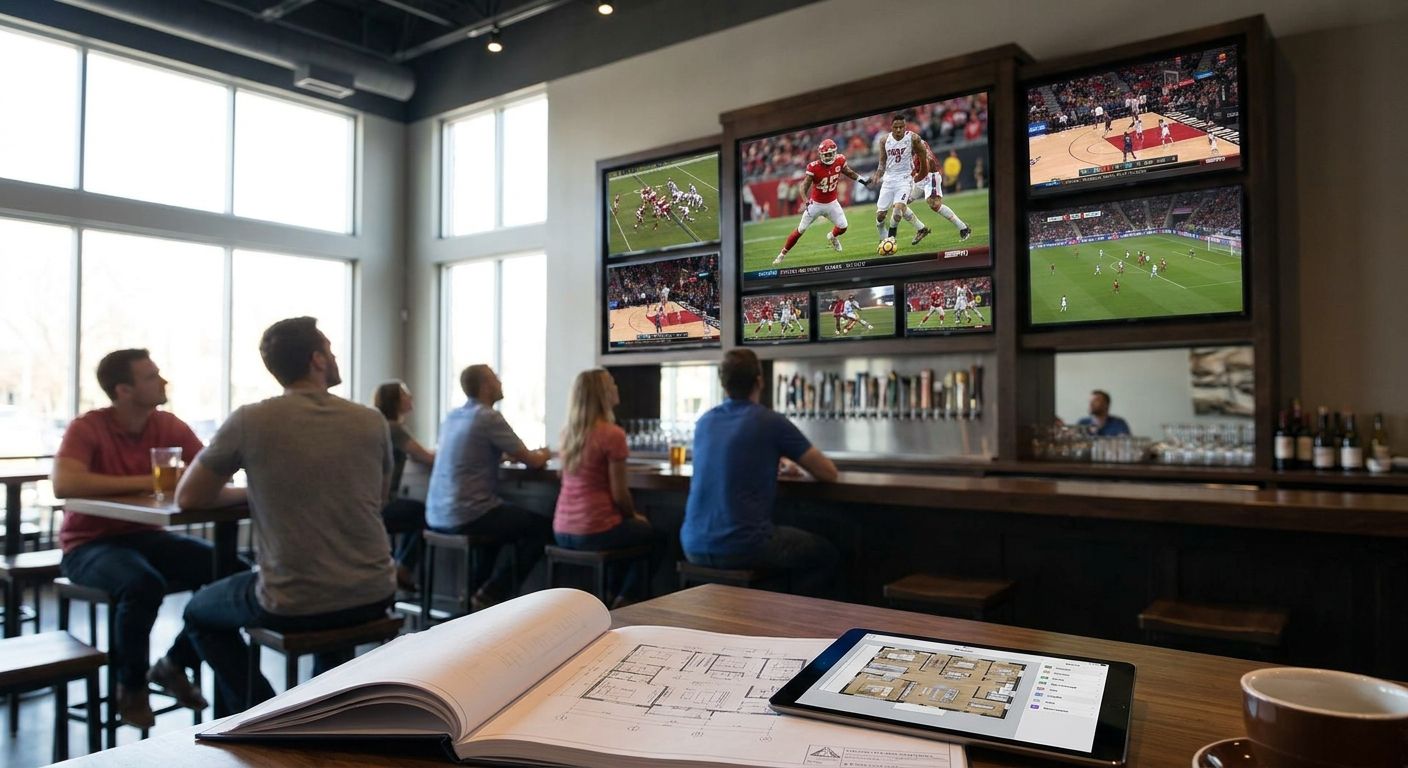
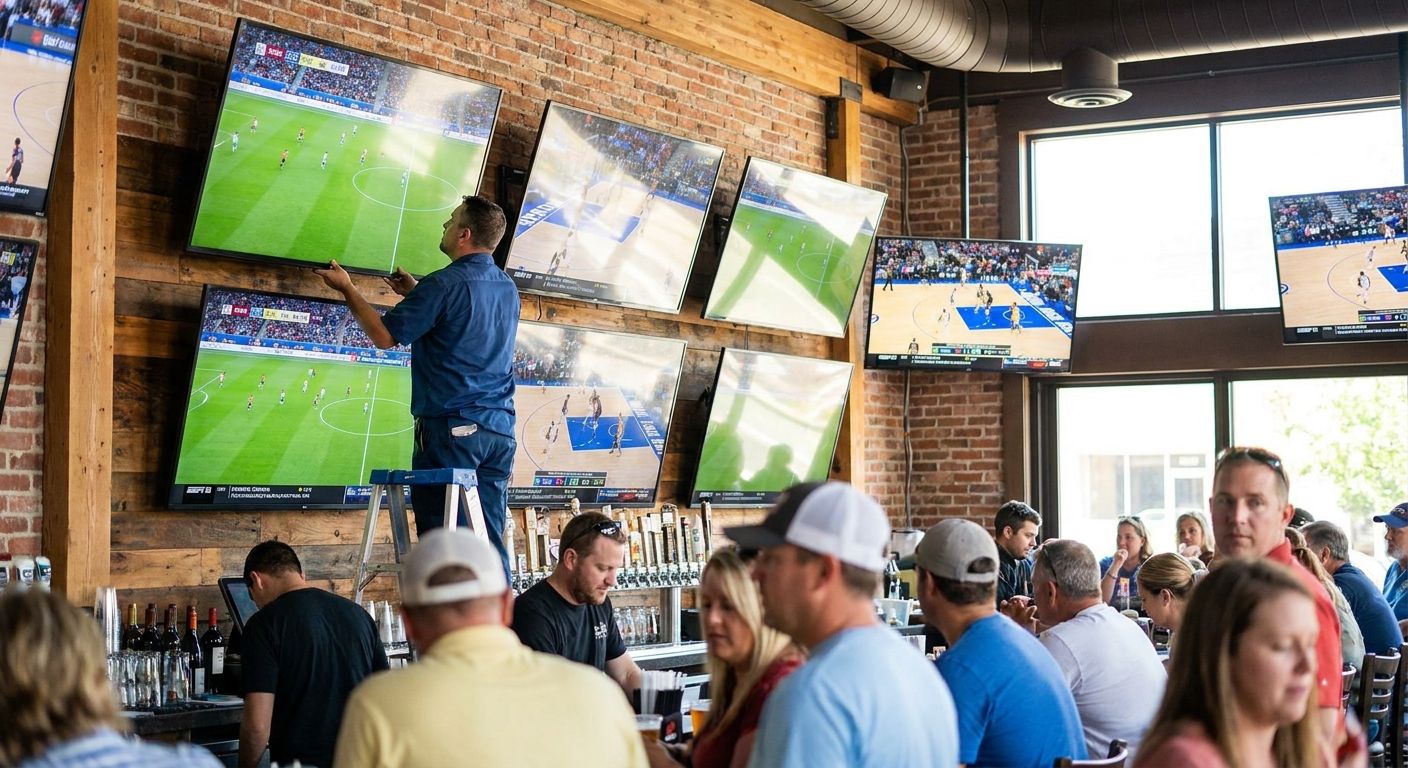
Sports bars and multi-screen venues need TV mounting that survives foot traffic, grease, condensation, and a Sunday crowd leaning on the bar rail — not a residential bracket stretched past its rating. This guide breaks down what to look for in tv mounting for sports bar projects across metro Atlanta, which mount types hold up, and what to skip before a contractor shows up with the wrong hardware.
- Full-motion articulating mounts are the workhorse pick for bar-back and corner screens in 2026 — Buy for any TV over 55 inches viewed from multiple angles.
- Fixed low-profile mounts win for main wall banks where every seat has a straight sightline — Buy for budget-conscious multi-TV walls.
- Outdoor-rated mounts are mandatory for patio bars in Georgia's humidity — Skip standard indoor brackets on any covered patio.
- The TV Mount Men has completed 10,000+ installations with a 5-year warranty on commercial and residential work across the metro.
Why this matters
A sports bar with eight TVs bolted in wrong runs into three problems fast: brackets rated for 60 pounds holding 85-inch panels that weigh closer to 90, cable runs left exposed where a server's tray catches them, and screens mounted flat when half the room sits at an angle that makes the picture unreadable. Fixing a bad mount after a bar is open means lost wall time during business hours. Getting the mount type and height right on install day is cheaper than a redo in 2026 or any year after.
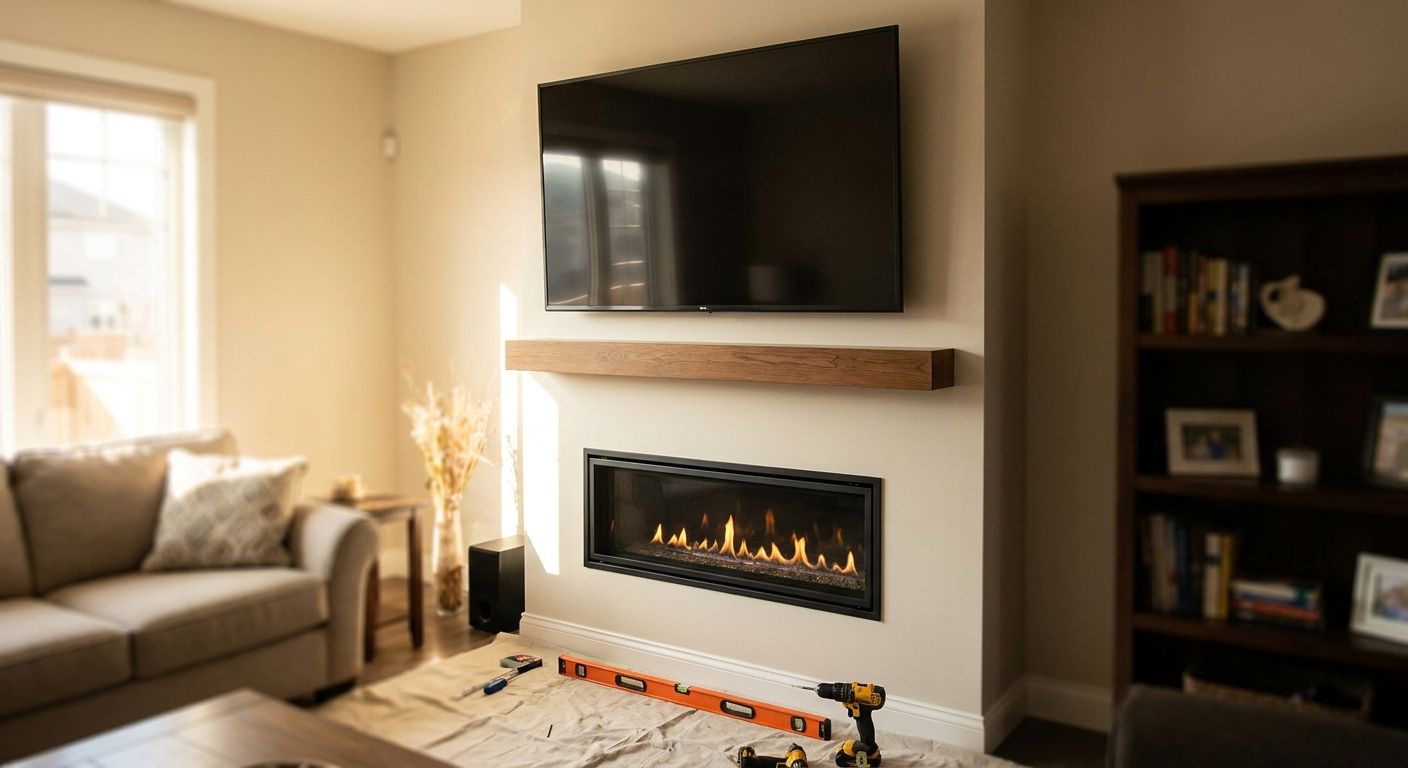
The TV Mount Men has handled residential jobs from Woodstock basements to Rockmart bedrooms, and the same load-rating and VESA-matching discipline applies at commercial scale — just with more screens, more traffic, and less room for error.
Who this is for
This guide is built for bar owners, GMs, and facilities managers planning a new build-out or a screen upgrade — anyone weighing full-motion versus fixed mounts across 6, 10, or 20 televisions, deciding whether the patio needs weatherproof hardware, or trying to figure out why last year's install already has a TV sagging on its bracket.
What to look for in TV mounting for sports bars
Weight capacity with margin, not just a match
A mount rated for exactly your TV's weight is a mount rated to fail under vibration from bass-heavy sound systems and constant door traffic. Look for brackets rated at least 20-30 pounds above the panel weight, especially for anything 75 inches or larger — a 100-inch commercial display can run north of 100 pounds before the bracket hardware.
VESA pattern match, verified before install day
Commercial displays don't always follow the same VESA spacing as consumer TVs of the same size. A mount ordered off a size chart instead of the actual VESA spec sheet is a mount that gets returned mid-job. Confirm the pattern against the manufacturer's spec, not the screen diagonal.
Viewing angle coverage for every seat
A fixed mount works when every table has a straight sightline — most main walls in a sports bar do. Corner TVs, bar-back screens, and anything near a bend in seating need tilt or full-motion articulation so the picture reads clean from a 45-degree angle, not just head-on.
Cable management that survives cleaning crews
Exposed HDMI runs and power cords near a bar top get caught, yanked, and eventually cut. In-wall cable channels or conduit behind the mount keep runs out of reach and out of sight, which matters more in commercial spaces than residential ones simply because of traffic volume.
Surface type — drywall, brick, or masonry block
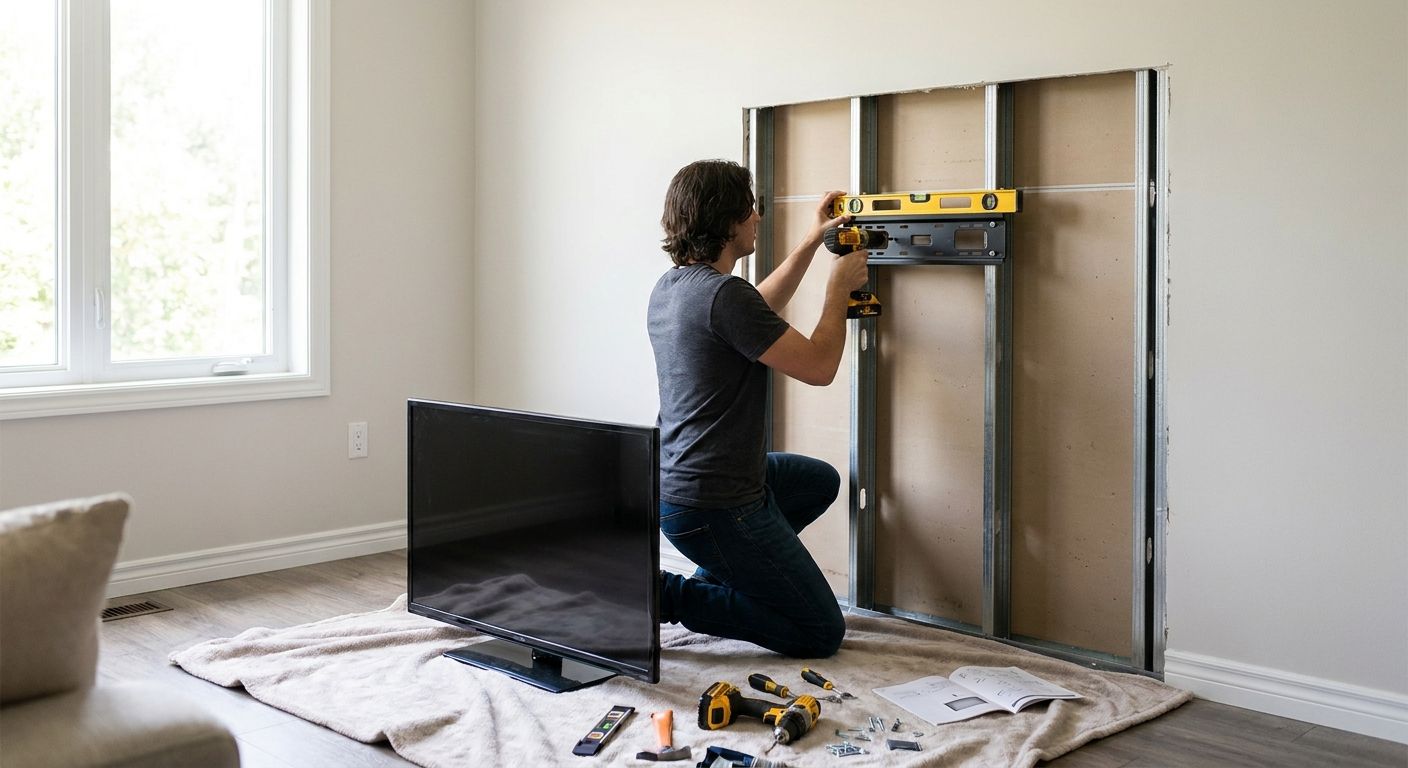
Many Atlanta-area bar buildings run brick or concrete block on exterior walls and drywall on interior partitions. Brick and block need masonry anchors and a different drill approach than drywall studs; a bracket install that ignores the wall material is the single fastest way to end up with a TV pulling loose.
Weatherproofing for patio and outdoor bar seating
Georgia summers bring heat and humidity that standard indoor mounts and standard TVs aren't built for. Outdoor-rated hardware and weatherproof-rated displays are non-negotiable for any screen on a covered patio or open-air bar section.
Get a quote for your venue
Multi-screen bar installs across metro Atlanta, quoted before you commit.
Top picks by mount type
Full-motion articulating mount — the workhorse pick. Handles tilt and swivel for corner and bar-back placements where viewers sit off-angle. Look for a load rating of at least 100 pounds if you're running 75-inch-plus panels, and confirm the arm extends far enough to clear bar-back shelving. Buy for any screen viewed from more than one seating zone. The approach mirrors what The TV Mount Men uses on residential multi-angle rooms, scaled up for commercial wall counts.
Fixed low-profile mount — the safe pick. Sits within an inch or two of the wall, ideal for a straight bank of TVs along a main viewing wall where every table faces forward. Lower hardware cost than full-motion, and the flush profile keeps screens out of the path of servers moving between tables. Buy for budget-conscious builds with straightforward sightlines.
Outdoor-rated mount — the weatherproof pick. Built with corrosion-resistant hardware and sealed housings for covered patios and open-air seating, where humidity and temperature swings degrade standard brackets within a season. The same weatherproofing logic that applies to outdoor patio and porch TV installs carries directly into commercial patio bars. Buy for any TV that isn't fully enclosed indoors.
Multi-screen wall configuration — the showstopper pick. A bank of 4-9 TVs on a shared mounting rail, common for sports bars running multiple games simultaneously. Requires precise stud or masonry layout and a cable plan run before drywall goes up if it's new construction. The multi-display planning that goes into home theater and man cave installs scales up to commercial video walls with the same alignment discipline. Consider for flagship walls where the visual impact matters as much as the game count.
Ceiling mount for center-of-room screens — the specialty pick. Drops a TV over a bar island or center pit where wall space doesn't exist. Needs a structural ceiling anchor point, not drywall alone, and a drop height that clears foot traffic below. Consider only when wall mounting genuinely isn't an option — it costs more in labor and hardware than a wall bracket.
What to avoid
- Consumer-grade tilt mounts on 75-inch-plus commercial displays. They look identical to commercial-rated hardware on a shelf but top out well below the weight of large panels — check the load rating stamp, not the box art.
- Flat fixed mounts near kitchen pass-throughs or grill lines. Heat and grease buildup on a mount that sits flush to the wall shortens the display's life faster than the same TV mounted with airflow clearance.
- Any indoor-rated mount on a covered patio. "Covered" isn't the same as climate-controlled — Georgia humidity gets into indoor-rated hardware within a season and corrodes the mounting plate.
Verdict comparison
| Mount type | Weight capacity fit | Viewing angle coverage | Weatherproof | Verdict |
|---|---|---|---|---|
| Full-motion articulating | 100+ lbs for large panels | Excellent, multi-angle | No | Buy for corner/bar-back |
| Fixed low-profile | Matches panel weight | Good, straight-on only | No | Buy for main wall banks |
| Outdoor-rated | Varies by model | Good | Yes | Buy for patio seating |
| Multi-screen wall rig | High, shared rail | Excellent | No | Consider for flagship walls |
| Ceiling mount | Structural, not drywall | Excellent, center-of-room | No | Consider when wall space is gone |
FAQ
What's the best TV mount for a sports bar?
A full-motion articulating mount is the best fit for most sports bar TVs viewed from multiple angles, especially corner and bar-back placements. Straight-sightline main walls do fine with a fixed low-profile mount instead.
How high should TVs be mounted in a sports bar?
Mounting height depends on seating distance and whether patrons view screens standing or seated, and it varies wall by wall in most bars. The goal is a viewing angle that stays comfortable from the farthest seat without forcing anyone to crane their neck.
Can outdoor patio TVs handle Atlanta summer heat?
Only outdoor-rated TVs and weatherproof mounts hold up through Georgia's humidity and heat cycles. Standard indoor TVs and mounts corrode or fail within a season on a covered patio.
Is TV mounting for sports bar different from home installation?
Yes — commercial installs deal with higher traffic, multiple wall materials in one building, larger panel counts, and cable runs that need to survive cleaning crews and server traffic. The mounting fundamentals are the same, but the load margins and cable protection get more conservative.
How much does commercial TV mounting cost in metro Atlanta?
Cost depends on the number of TVs, mount type, and wall surface, so pricing is best confirmed with a project quote rather than a flat rate. Multi-screen bar walls and patio installs typically price differently than a single interior mount.
Do sports bars need special brackets for 85-inch or 100-inch TVs?
Yes — panels at that size often exceed 90-100 pounds and need brackets rated with 20-30 pounds of margin above the TV's actual weight. A bracket sized to match the TV exactly, rather than exceed it, is a common point of failure.
How long does a multi-screen bar installation take?
Timeline scales with TV count, wall material, and whether cable runs are in-wall or surface-mounted, so it varies project to project. A straight bank of fixed mounts on drywall moves faster than a mixed brick-and-drywall multi-screen wall.
Is a full-motion mount worth it for bar-back screens?
Yes, when the screen is viewed from more than one seating zone or angle, which is the case for most bar-back placements. A fixed mount only makes sense when every viewer sits directly in front of the screen.
One last thing
The detail most bar owners skip: running a new outlet behind each mount point before the TV goes up, the same way it's done on residential jobs like a kids' bedroom install in Acworth or a basement setup in Woodstock. On a commercial wall with 6-10 screens, retrofitting outlets after the mounts are up means pulling TVs back down — plan the electrical with the mounting layout, not after it.