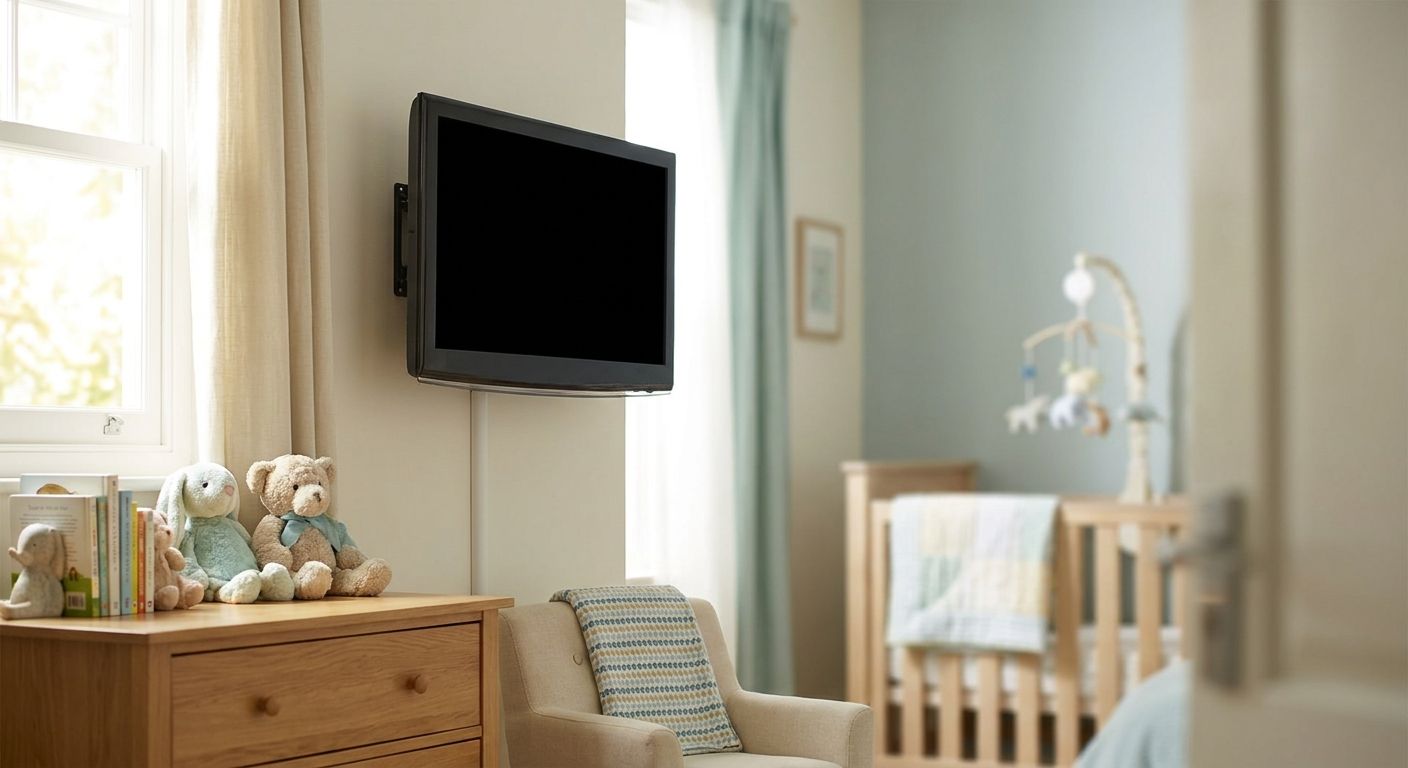
Mounting a TV in a kid's room or nursery isn't the same job as mounting one in a living room — cord safety, tip-over risk, and wall height all change once a toddler is in the room.
- Fixed mounts anchored into studs beat furniture-top TVs for tv mounting for kids room setups — buy fixed, skip freestanding stands.
- Mount height for a child's bed or crib-adjacent wall runs 40-48 inches to center, not adult eye level.
- The TV Mount Men has completed 10,000+ installations across metro Atlanta with a 5-year warranty on every mount.
- Cord concealment kits cost less than a re-do after a toddler pulls a cable loose — plan for it up front.
- Renters and condo owners need stud-only, no-drill, or HOA-compliant mounting — check before you buy hardware.
Why this matters
A TV in a bedroom or nursery sits closer to a crib rail, a toddler bed, or a play area than any living room installation. That changes three things: mount height, anchor strength, and cord routing.
Standard TV mounting advice assumes an adult sitting on a couch eight feet back. In a kids' room, the viewer is shorter, closer, and more likely to pull, climb, or yank a loose cord. TV mounting for kids' bedrooms needs different hardware decisions than a den or home theater, even when the wall and TV size are identical.
Who this is for
This guide is for parents and caregivers mounting a TV in a child's bedroom, playroom, or nursery — whether that's a 32-inch set on a toddler's wall or a 40-inch TV going into a tween's room ahead of 2026. It also covers renters and condo owners who need a mount that doesn't damage drywall or violate an HOA rule, since kids' rooms are disproportionately in rental units and starter homes.
What to look for in TV mounting for kids' room installs
Stud anchoring, not drywall anchors alone
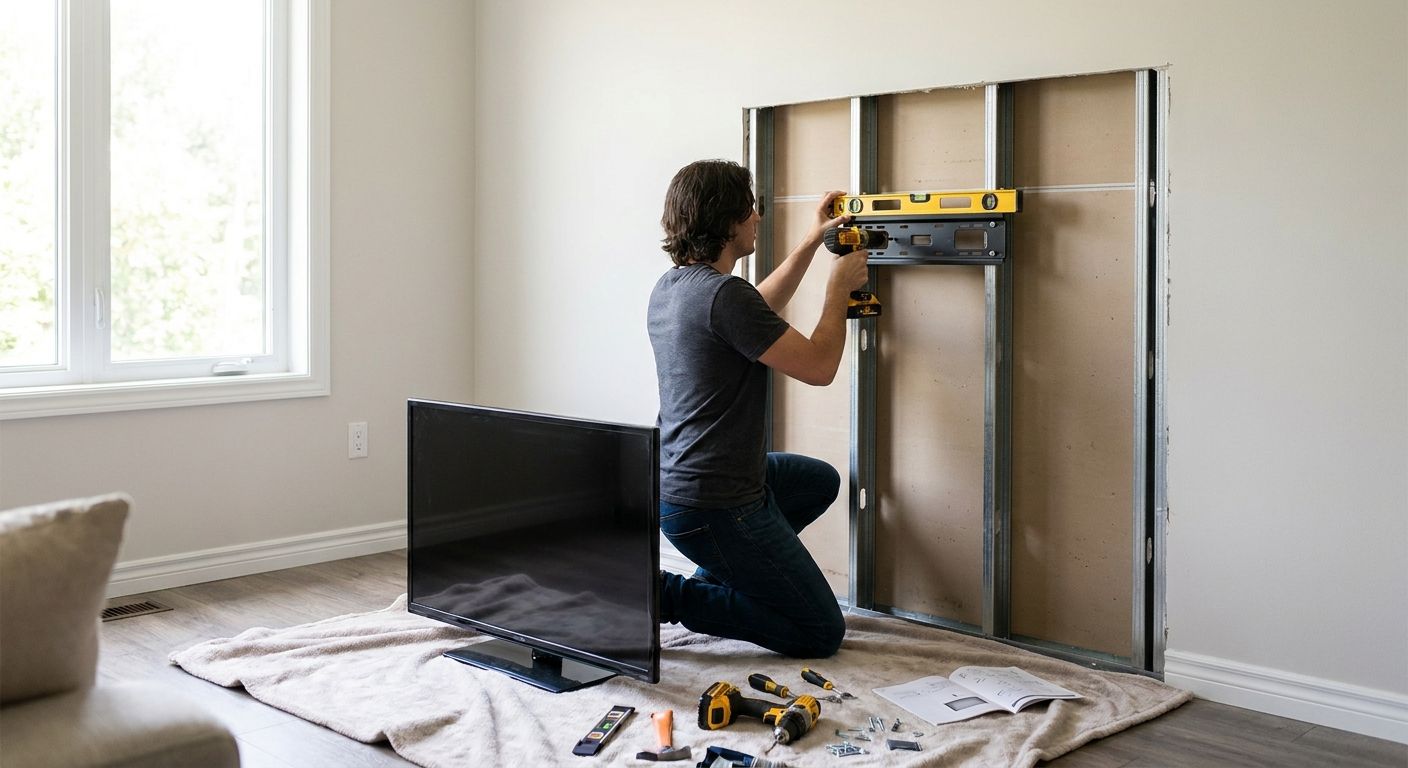
Drywall toggle bolts hold a TV until something pulls on it — a toddler grabbing the bottom bezel, a bunk bed pushed against the wall, a game of catch gone wrong. A mount anchored into wall studs, spaced roughly 16 inches on center in standard framing, holds significantly more shear weight than drywall anchors alone. For any TV over 32 inches in a kids' room, stud mounting isn't optional.
Anti-tip hardware if the TV isn't wall-mounted
If a TV sits on a dresser or low console instead of the wall, an anti-tip strap or bracket anchoring it to the furniture is standard safety practice recommended by the Consumer Product Safety Commission for any room where young children are present. This is one of the strongest arguments for wall mounting over furniture placement in a nursery or toddler room in the first place.
Mount height calibrated to a child's eye line
Adult eye-level mounting guides put screen centers around 60 inches. In a kids' room, that's often too high — a child sitting on a bed or the floor needs the screen closer to 40-48 inches to center, depending on ceiling height and furniture placement. Height matters more here than in any other room type, since it changes the neck angle for a 4-year-old differently than for a 12-year-old.
Cord concealment that survives curious hands
A cord hanging down a wall is a pull hazard and a chew hazard. In-wall cord concealment kits or channel raceways route power and HDMI cables inside the wall or under a rigid cover, keeping cords out of reach entirely. This matters more in a nursery than a media room — a loose cord near a crib is a different risk category than one near a couch.
Wall type and rental restrictions
Apartments, condos, and HOA-governed homes often restrict what can be drilled into shared or exterior walls. Anyone mounting in a rental unit or condo should confirm what's allowed before buying hardware — TV mounting for apartments and rental properties covers no-drill and low-damage options that still hold securely.
Bracket type matched to how the room is used
A nursery TV rarely needs to tilt or swivel — it's viewed from one spot. A tween's bedroom TV, watched from a bed at different angles, benefits from a tilting or full-motion arm. Buying more articulation than the room needs adds cost and installation complexity without a real benefit.
Top picks for kids' room TV mounts
Fixed mount — the safe pick. Zero moving parts means zero pinch points and the lowest profile off the wall, often under 1 inch. This is the right call for nurseries and toddler rooms where the TV is watched from one fixed spot on the floor or a single chair. Buy for any room with a child under 6.
Tilting mount — the flexible pick. Angles the screen down 5 to 15 degrees to cut glare from a window or overhead light, which matters in west-facing bedrooms that get afternoon sun. Slightly more hardware than a fixed mount but still low-profile. Buy for tween and teen rooms where the TV sits above eye level.
Full-motion mount — the wildcard. Swings the TV out and pivots it toward a bed or reading nook, useful in a shared kids' room where the viewing spot changes. Adds more exposed arm hardware, which is a consideration if a toddler can reach the mount itself. Consider for rooms shared by older kids only; skip for nurseries.
Furniture-top placement with anti-tip strap — the budget pick. No wall drilling, works in a strict no-mount rental, and can move with the furniture. Requires a rated anti-tip anchor kit and a stable, low dresser — never a tall or narrow stand. Consider only when wall mounting is genuinely not allowed, as in some condo and HOA communities.
Get a kids' room TV mount quoted
Stud-anchored mounts, cord concealment, and height calibrated for a child's room.
What to avoid in nursery and kids' room TV setups
- Drywall-only anchors on TVs over 32 inches. They pass a weight rating on paper but don't account for a child pulling on the bottom edge — stud anchoring is worth the extra 20 minutes of work.
- Full-motion arms directly over a crib or toddler bed. Even locked in place, an arm mount extends the TV's reach into the room, closer to small hands than a flush fixed mount.
- Loose or coiled cords left hanging. A cord that looks tidy at install can become a pull hazard within weeks once a toddler starts standing and reaching.
Verdict comparison: kids' room mount types
| Mount type | Best for | Profile off wall | Cord risk if unconcealed | Verdict |
|---|---|---|---|---|
| Fixed | Nurseries, toddler rooms | Under 1 inch | Low | Buy |
| Tilting | Tween/teen rooms, sunny walls | 1-2 inches | Low-Medium | Buy |
| Full-motion | Shared rooms, multiple viewing spots | 3-6 inches extended | Medium | Consider |
| Furniture-top + anti-tip | No-drill rentals only | N/A | Medium-High | Consider |
FAQ
What's the best TV mount for a kids' bedroom?
A fixed, low-profile mount anchored into wall studs is the best choice for most kids' bedrooms and nurseries in 2026. It has no moving parts to pinch small fingers and sits flush against the wall, out of reach.
Is it safe to mount a TV above a crib?
Mounting directly above a crib isn't recommended because it puts the TV, mount hardware, and any cords within a child's eventual standing reach. A side wall or a wall opposite the crib is the safer placement.
How high should a TV be mounted in a child's room?
For a child viewing from a bed or the floor, center the screen around 40-48 inches from the floor rather than the 60-inch adult eye-level standard. Exact height depends on ceiling height and furniture placement.
Do I need an anti-tip strap if my TV is wall-mounted?
No — a properly stud-anchored wall mount eliminates the tip-over risk that anti-tip straps address. Anti-tip hardware is only necessary when a TV sits on furniture rather than the wall.
Can renters mount a TV in a kids' room without drilling into drywall?
Yes, low-damage and no-drill mounting options exist for rental units, though weight capacity and stability are lower than a stud-anchored mount. Check the property's rules before choosing hardware.
How do I hide TV cords in a nursery?
In-wall cord concealment kits route power and HDMI cables inside the wall cavity, which is the most secure option for a nursery. A rigid cord raceway cover is the next-best option when in-wall routing isn't possible.
What size TV is appropriate for a kids' bedroom?
32-inch and 40-inch TVs are the most common sizes installed in kids' bedrooms, based on typical room dimensions and viewing distance from a bed. Larger sizes work in bigger rooms but increase the importance of stud anchoring.
Should a full-motion mount be used in a toddler's room?
Full-motion mounts are better suited to older kids' and shared rooms rather than toddler rooms, since the extended arm brings the TV closer to a child's reach. A fixed mount is the safer default for children under 6.
One last thing
The detail most parents skip is checking cord concealment before the TV goes up, not after — retrofitting an in-wall cord kit around a mounted TV takes longer and costs more than routing it during the original install. If the room is a nursery, ask for the cord routing to be finished and inspected before the crib goes back in place, not scheduled for later.