The best TV mount for kids room use isn't the same mount you'd put in a living room. A nursery or bedroom wall needs a lower weight profile, anti-tip anchoring, and cord management that stops a toddler from turning a bracket into a ladder. This guide ranks the mount types that hold up in a kids' bedroom or nursery in 2026, based on install patterns from jobs across metro Atlanta, plus what a licensed installer checks before drilling a single hole.
- Fixed low-profile mounts win for nurseries and toddler rooms in 2026 - Buy.
- Full-motion articulating mounts are a Skip under age six - too much leverage for small hands.
- Anti-tip anchoring is non-negotiable for any TV over 32 inches in a kids' room.
- No-stud specialty anchors solve the off-center stud problem common in older Georgia homes.
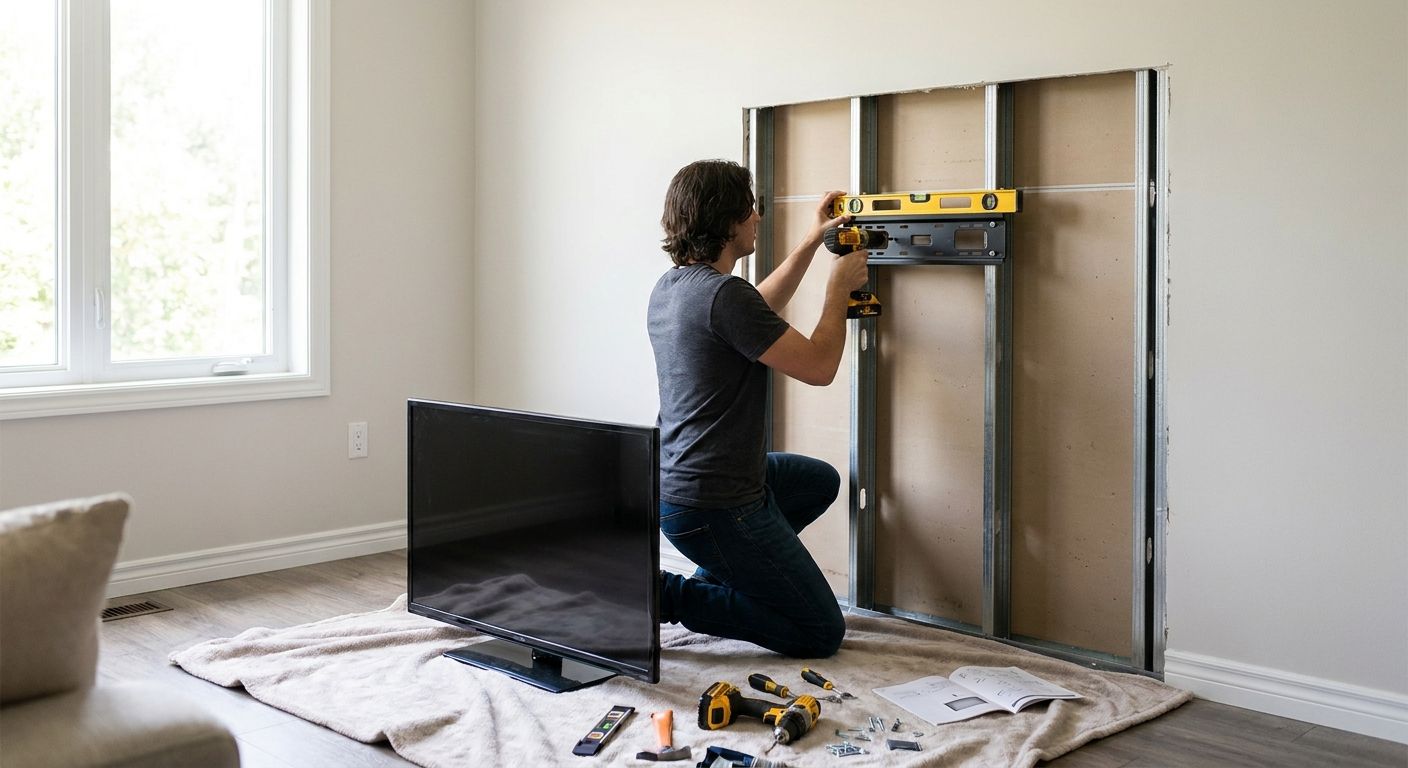
- Stud-anchored professional installation beats drywall anchors alone on every kids' room job.
Why this matters
A TV that's mounted wrong in a kids' room isn't a cosmetic problem, it's a load-bearing one. The Consumer Product Safety Commission runs its Anchor It! campaign specifically because unanchored TVs and furniture are a documented tip-over hazard in bedrooms where kids climb. A mount rated for the screen's weight but installed into drywall alone, with no stud contact and no anti-tip strap, is the single most common mistake seen on kids' room jobs in 2026.
The fix isn't complicated. It's picking the right mount category for the room, then anchoring it correctly. TV mounting for kids' bedrooms and nurseries covers the install side; this guide covers which mount type to start with.
How we ranked
Each mount type below is scored against five criteria that matter specifically in a kids' room: weight capacity relative to typical bedroom TV sizes (32 to 55 inches), tilt range for low seating angles like a floor bed or crib-adjacent chair, cord concealment options, compatibility with anti-tip hardware, and how forgiving the mount is when a stud lands off-center from the ideal viewing height. That last point comes up constantly on older Georgia homes in towns like Woodstock, Acworth, Rockmart, and Carrollton, where 16-inch on-center framing doesn't always line up with where a parent wants the screen. Ranking reflects which mount categories consistently pass those five checks versus which ones create extra risk in a room a toddler has unsupervised access to.
The ranked list
1. Fixed low-profile mount — the safe pick
A fixed mount holds the TV flat against the wall, typically 1 to 1.5 inches off the surface, with no swivel arm or pivot point for small hands to grab. Weight capacity on standard fixed mounts runs up to 100 lbs, which covers nearly every TV size used in a bedroom or nursery. There's nothing to extend, tilt, or pull down, which is the entire point in a room with a crib or a toddler bed.
For a nursery or a room for kids under six, this is the starting point every time. TV mounting for kids' bedrooms and nurseries is built around this exact mount category. Verdict: Buy.
2. Tilting mount — the flexible pick
A tilting mount adds a small downward angle, usually 0 to 15 degrees, which matters when the viewing spot is a floor bed, a bean bag, or a low chair rather than a couch. It still keeps the TV close to the wall with a limited weight rating similar to a fixed mount, so it doesn't sacrifice the safety profile.
This is the right call for a slightly older kids' room where the seating height is lower than a standard bedroom setup. Verdict: Buy for rooms with floor-level seating, Consider everywhere else.
3. Full-motion articulating mount — the wildcard
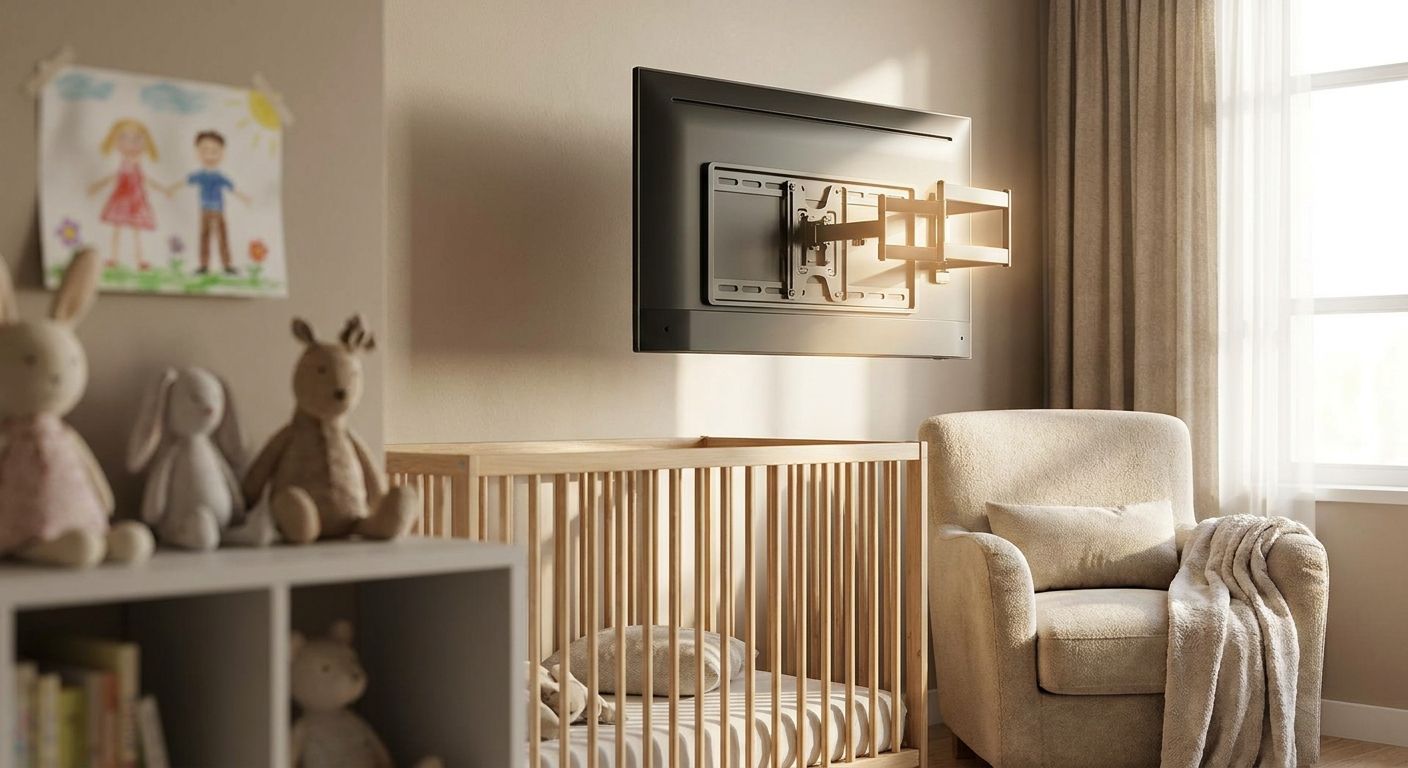
A full-motion mount extends 20 inches or more off the wall and swivels close to 180 degrees. That's useful in a shared playroom-nursery combo where the viewing angle changes, but the extension arm is exactly the kind of leverage a climbing toddler can use to pull a screen off a wall stud.
The hardware itself isn't unsafe. The problem is the room. Verdict: Skip for any room used by a child under six, Consider for a tween or teen bedroom where the extra reach is actually useful.
4. No-stud specialty anchor mount — the workaround
When the ideal viewing height doesn't line up with a wall stud, a no-stud specialty anchor spans the gap using a toggle-bolt plate or a stud-spanning bracket rather than relying on drywall alone. This shows up often in older homes around Rockmart and Carrollton, where framing spacing doesn't match modern layout expectations.
It's not the first choice, it's the fix when the first choice doesn't line up structurally. Verdict: Consider only after a licensed installer confirms actual stud placement.
5. Anti-tip strap or security kit add-on — the non-negotiable
This isn't a standalone mount, it's the hardware that locks any mount above to the stud plate instead of relying on drywall anchors as the only line of defense. It's a small, low-cost addition that pairs with a fixed, tilting, or no-stud mount.
Skip this in a kids' room and the mount category above stops mattering. Verdict: Buy, always, for any TV over 32 inches in a kids' bedroom or nursery.
6. Ceiling swing-arm mount — the overkill
A ceiling-mounted swing arm adds a pivot point extending 12 inches or more from the ceiling, which is more moving hardware than a bedroom setup calls for and introduces another failure point above a child's bed. It solves a problem most kids' rooms don't have.
Verdict: Skip.
“An anti-tip strap costs less than a night out, and it's the difference between a wall-mounted TV and a TV on top of a toddler.”
Comparison table
| Mount Type | Best For | Typical Weight Rating | Tilt / Swivel | Verdict |
|---|---|---|---|---|
| Fixed low-profile | Nurseries, toddler rooms | Up to 100 lbs | None | Buy |
| Tilting | Floor-seating kids' rooms | Up to 100 lbs | 0-15 degrees | Buy |
| Full-motion articulating | Tween/teen bedrooms only | Up to 125-150 lbs | Full swivel + extension | Skip under 6, Consider 6+ |
| No-stud specialty anchor | Off-center stud placement | Depends on hardware | Varies | Consider |
| Anti-tip strap add-on | Every kids' room install | N/A (safety hardware) | N/A | Buy, always |
| Ceiling swing-arm | Not recommended for kids' rooms | Varies | Full swivel | Skip |
Where to get it installed
- Match the mount to the VESA hole pattern on the back of the actual TV, not to the room size. A mount sized for the wrong hole spacing doesn't fit no matter how good the weight rating looks.
- Insist on stud-anchored hardware for anything over 32 inches in a kids' room. Drywall anchors alone aren't rated for the sustained load plus the occasional tug from a curious kid.
- Bundle the anti-tip strap into the same job instead of adding it later. It's a five-minute addition during install and a much harder retrofit after the wall is closed up.
The TV Mount Men installs all five recommended mount categories across metro Atlanta with licensed, insured crews and a 5-year warranty on the work, backed by 300+ five-star reviews and 10,000+ installations to date. If the room is a rental, check the lease before drilling; TV mounting for apartments and rental properties covers what's usually allowed and what isn't.
Get a kids' room TV mounted safely
Licensed installers, stud-anchored mounts, 5-year warranty.
FAQ
What's the best TV mount for a kids room in 2026?
A fixed low-profile mount is the best TV mount for kids room use in 2026, since it has no swivel arm for a toddler to grab and holds up to 100 lbs. Add an anti-tip strap anchored into a wall stud for any screen over 32 inches.
Is a full-motion mount safe for a toddler's room?
No, a full-motion mount is a Skip for a toddler's room because the extension arm gives leverage a climbing child can use against the bracket. It's a better fit for a tween or teen bedroom where that reach is actually useful.
How much weight can a nursery TV mount hold?
Standard fixed and tilting mounts used in nurseries carry up to 100 lbs, which covers essentially every TV size sold for a bedroom. Full-motion mounts run higher, up to 125-150 lbs, but aren't recommended for young kids' rooms regardless of capacity.
Do I need an anti-tip strap for a wall-mounted TV?
Yes, for any TV over 32 inches in a kids' bedroom or nursery, an anti-tip strap anchored to a wall stud is non-negotiable. It's the hardware that keeps the mount from separating from the wall if a child pulls on it.
Can a TV mount go into drywall alone in a kids' bedroom?
Drywall anchors alone aren't rated for the sustained load of a wall-mounted TV plus occasional pulling from a child. Stud-anchored hardware, confirmed by a licensed installer, is the safety baseline for a kids' room in 2026.
What height should a TV be mounted in a kids' room?
Height depends on the seating setup; a floor bed or low chair calls for a lower mount with some tilt, while a standard bed height works with a fixed mount closer to eye level. There's no single fixed number, it's set by where the child actually watches from.
How much does professional TV mounting cost for a kids' room in metro Atlanta?
Cost depends on wall type, mount hardware, and whether an outlet needs to be added behind the TV. Check current pricing directly with an installer for the specific room setup.
Should renters mount a TV in a kids' room?
Renters should check the lease before any wall-mounted install, since drilling into studs is a structural change some landlords restrict. Apartment-specific mounting guidance covers what's typically allowed.
One last thing
The part most parents miss isn't the mount category, it's the bottom edge of the TV. A screen mounted with its bottom edge within a toddler's reach turns into a step-stool target regardless of how good the anti-tip hardware is. Installers who work kids' rooms regularly push the mount height up specifically to keep that bottom edge out of climbing range, not just to hit an ideal eye-level number.